If you’re going to go the adult contemporary route, you
might as well have the courage of your convictions. Closing an album with a
four-minute a cappella “Quiet Joys of Brotherhood” (by Richard Farina/Sandy
Denny), well, that counts. To get there, we listen through everything from
Jimmie Rodgers to Donovan, all flattened into the same politely pleasant
folk/country/bluegrass hybrid sway. Gene Parsons allows himself one homespun
instrumental as on the solo LPs of old, and Meridian Green keeps herself
restrained and kinda dull (her rare almost-guttural moments fall well short of
what, say, Alannah Myles was doing at the time; feral, they are not). They seem
pretty happy together—if you don’t pick that up from the cover, she’s “cooing
like a dove/I’m so in love with you” on track 2 to remind you. Upon the release of this
album, Lux Interior and Poison Ivy probably threw up on one another in protest.
Thursday, June 13, 2013
Wednesday, June 12, 2013
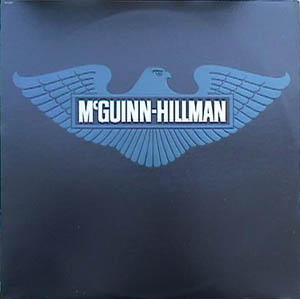
McGuinn-Hillman (1980)
I have no idea who opened for Loverboy or Eddie Money in
1980, but I do know, with absolute certainty, that they sounded exactly like this
album: crisp ringing trebly guitar chords hanging in the air, faux-anthemic synth climbs to anticlimactic pseudo-crescendos, plenty
of open space for live handclaps, and not a song in sight. Drowning out the
sad, lazy all-filler tracks is the giant sucking sound of the now-absent Gene
Clark, responsible for many of the best moments in the previous McGuinn-Hillman
affairs. In his place are a nonsensically sequenced consecutive double whammy
of Graham Parker tunes on side 1, a procession of farmed-out hack-written songs
neither better nor worse than the former Byrds’s inert originals, and the
grinding death throes of the promises of the 1960s. I guess this is what
America deserved for electing Reagan.
Capitol seemed to know this one was slated for oblivion; as
far as I can tell, between the front and back covers, the target audience for
this LP was inattentive bikers impulse-buying based on the logo, sunburn victims, and barefoot survivalists
surfacing from their fallout shelters to buy batteries.
Tuesday, June 11, 2013
Crosby/Nash, Live (1977)
Graham Nash’s “Simple Man” followed by David Crosby’s
“Foolish Man” at the start of side 2 here summarizes the intertwined careers of
these buffoons better than any belabored snark possibly could. There are
probably less essential albums out there—Rednex’s 1994 Sex & Violins comes to mind, though even Whale’s 1995 We Care just barely avoids the classification, “Hobo Humpin’ Slobo Babe” and all—but few less interesting ones. This just plods along,
not even bothering to grab for the duo’s grade-A material, whatever that might
be. If four minutes of Nash’s “Mama Lion” seems interminable, that’s only
because you haven’t yet reached the epic closer, nearly ten excruciating
minutes of Crosby’s orgy-of-idiocy “Déjà Vu.”
Sunday, June 9, 2013
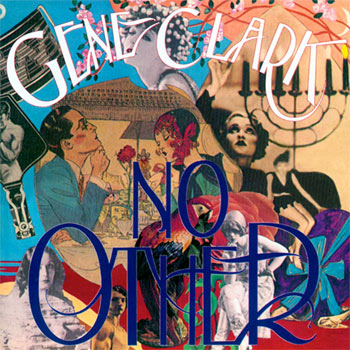
Gene Clark, No Other (1974)
Visionary maximalist psychedelic country-rock albums are
hardly in abundance, with good ones more rare yet. So it wouldn’t seem like
Gene Clark was tapping a goldmine here—nor did the immediate results vindicate
him, with the album flopping and
meeting critical disinterest.
Gene Clark was right, and everyone else was wrong. More than
just the great lost Byrds-member album (and let’s face it, it doesn’t take much
to rank high in this particular canon), this is one of the great lost 70s
albums, period. Thomas Jefferson Kaye’s production is bombastic but genuinely
exploratory, slithering funk bass and constant keyboard hum and even Chris
Hillman stopping by with his mandolin all contributing to rather than distracting
from Clark’s grasp for transcendence. On the lyric sheet some of it reads as
mystical babbling, but the delivery sells it—when he asks, “Have you seen the
old world dying,” you don’t doubt that he
has, and when "Some Misunderstanding" briefly totters toward formlessness, that voice, all yearning and longing and reminding that "we all need a fix," pierces the fog and pulls it together. Even if that old world for Clark might have been his sobriety—while “Life’s
Greatest Fool” and “The True One” might have fit in on his earlier solo albums
(high praise indeed), closer “Lady of the North,” co-written with
Doug Dillard and the only shared songwriting on the record, shows how far
things have moved from the Dillard & Clark albums. This is what they might
have sounded like with a symphony and a mountain of blow—accoutrements that
might crush a lesser talent, and which couldn’t possibly be sustained even by
Clark, but which coalesce here into eight long songs (with no conceivable radio
single in sight--oh, how David Geffen must have fumed) that form one unbroken,
nearly perfect, suite. No Byrd ever put out, or even played on, a better album
than this.
Too bad about the cover art, though. As much as I endorse
the destabilization of gender roles, the strikingly attractive Clark looks terrible in bad makeup and (I think?)
drag on the back:
Wednesday, June 5, 2013
The Souther-Hillman-Furay Band, Trouble in Paradise (1975)
Writing bland MOR rock must be more exhausting than it
seems, because all these guys can squeeze their muses for is an average of
three songs apiece, which really bleed together into one unbroken procession of
musical, lyrical, and performance banality. Apparently Richie Furay was born
again in the interim since the first SHF LP, so imagining the recording or the backstage of a show is
vastly more entertaining than listening to the damn thing. Hillman nearly comes
to life on “Follow Me Through,” buried deep on side two, but the arguable
keeper is (as on round one) Souther’s “Mexico,” whose half-assed, shrugged-off tale of
infidelity is an apotheosis of this scene’s darkness-free easy-sleazin’—not to mention a perfect embodiment of what Steely Dan was mocking in “Deacon Blues.”
Tuesday, June 4, 2013
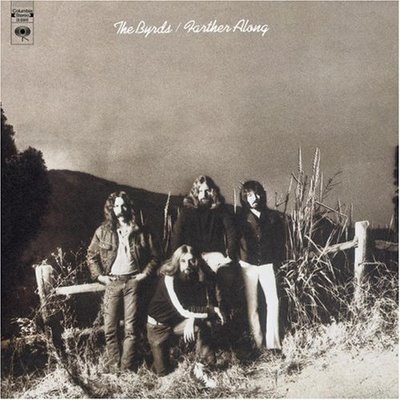
The Byrds, Farther Along (1971)
Timing and production, they matter: I could see
this ramshackle album recorded on a four-track in 1996 getting some underground
traction, and I could see it slathered in Byrdsmaniax
overdubs, coming out in 2007 on Sub Pop as a Fleet Foxes opening act. Recorded
near-live in 1971, right after the aforementioned flop, it too wilted on the vine. If not a lost masterpiece, it still
deserved better, as Gene Parsons and Clarence White really showed themselves
the center of the group, Roger McGuinn overcame his lifelong songwriting stupor
to kick things off with the self-penned chugging 50s-style riffage of “Tiffany
Queen” (one of the most overlooked Byrds gems, with even modestly clever lyrics
from Our Man of the Norman Vincent Peale Reading Club), and the wretched
Skit Battin/Kim Fowley songwriting duo pushed their obnoxiousness into relative
remission here. We even get a moving dead-dog tribute.
Probably this was all they had in them and it’s just as well
the road ended here (it’s the final LP in the organically continuous life of
the Byrds, with the 1973 original-lineup return a reunion rather than a next-album). But the thing deserved better
than the critical and commercial neglect it received—even the bonus tracks on
the CD reissue kinda kill it.
Saturday, June 1, 2013
The Byrds, Byrdmaniax (1971)
The near-universal consensus is that producer Terry Melcher
killed this album by drowning it in sickly sweet strings and horns. Which gives
him both too much and too little credit; okay, he lays it on thick, no
question, but this was bound for mediocrity no matter who tweaked the knobs.
Nothing could polish these tunes into gold, nor does Melcher entirely stifle what is
there; McGuinn’s gentle but simple “Kathleen’s Song” was going to be
endearing but forgettable whether or not swirling symphonic fills were crammed
into its open spaces.
That and the Gene Parsons co-write “Pale Blue” are the
fearless leader’s most—only—valuable
contributions (the less said about his faltering stab at political commentary,
“I Wanna Grow Up To Be a Politician,” the better; on his go-to co-composer
Jacques Levy, let even less be said). Team Battin/Fowley can’t compete with
even that, turning in more of the lazy pap that marked Battin’s Byrdsian
contributions. Clarence White moves behind the mic for a few songs, credibly
enough, though surely even the young Jackson Browne had better offerings for
him to cover than “Jamaica Say You Will.”
At least they were smart enough to leave off the
once-requisite Dylan cover that traded in and simplified the complicated
sneer/sorrow combo of “Just Like a Woman” for a more straightforwardly
sentimental version that thus missed the point. Otherwise,
all the markings of a slapdash contract filler are here, including the goofy,
unappealing cover and title. Ladies and gentlemen, this is what uninspired
journeyman rock music feels like.
Subscribe to:
Posts (Atom)