Showing posts with label Clarence White. Show all posts

Saturday, April 5, 2014

The Byrds, Live at the Fillmore, February 1969 (2000)


No question  about it, I was a skeptic: the damn band put out a live record in 1970, so what’s the point of this beyond cynical label cash-grab?

And probably that was the point, since what else motivates labels? But that doesn’t stop this from asserting its own identity, independent of (Untitled), and capturing the band precisely at a transitional moment. It had only been four years since they broke big, but it seemed careers ago; they’re clearly eager to move beyond the past, cramming “Turn! Turn! Turn!”, “Mr. Tambourine Man,” and “Eight Miles High” into one oldies-hit-parade medley that they blast through in a ten-minute fury (as opposed to the sprawling side-long “Eight Miles” on the 1970 record). It works—while McGuinn is rarely an impassioned singer (to his frequent detriment), he shouts himself hoarse on a “So You Want To Be a Rock’N’Roll Star” that could nearly pass as a punk band in 1978, all clanging chords and John York swooping through on bass.

But the band wants to play its new material, and while the just-released Dr. Byrds and Mr. Hyde was hardly a high point, they rock “King Apathy III” as if it were, and almost convince. McGuinn’s vocals on the tracks that Gram Parsons would also claim separately (esp. “Sing Me Back Home” and “Close Up the Honky Tonks”) can’t help suffering in comparison, but he and the rest of the group seethe through a fantastic “This Wheel’s on Fire,” and close things out with more Dylan, a rousing “Chimes of Freedom.” Even the generally lackluster “He Was a Friend of Mine”—always one of my least-favorite Byrds songs, a treacly tread of misplaced nostalgia—comes to life. I still have no idea why both McGuinn and Parsons were so thin-skinned about being dissed by a DJ that they both kept “Drug Store Truck Drivin’ Man” in their sets, but at least it dies before the 2:30 mark. Even David Fricke’s liner notes deliver—the idea of the first Byrds show at the Fillmore, in 1966, occurring alongside a production of LeRoi Jones’ The Dutchman is just kind of astonishing—as is the fact that they were reduced to opening for some Butterfield Blues Band dudes by the point of this recording. Huh? 


Thursday, February 13, 2014

The Byrds, Dr. Byrds and Mr. Hyde (1969)


Clarence White is here, and he ain’t yer Sweetheart: he rings this LP in with some crashing chords that bring “This Wheel’s on Fire” closer to Blue Cheer than Gram Parsons. Later, fellow Byrd-n00b Gene Parsons adds such a cavernous drum sound to “Child of the Universe” that one might mistake it for a guest appearance from John Bonham. This is what happens when you repopulate a rock band in 1969, apparently. 

Dr. Byrds and Mr. Hyde is an odd, deeply uneven LP, lost in the shadows of 1968’s moment in the sun, and their biggest commercial dud, according to David Fricke’s reissue liner notes (which strive nobly, if futilely, to reclaim it as "the Great Forgotten Byrds Album"--it is one of those things, but not both). I’ve been listening to it every other year or so for a decade, and have only just begun to appreciate it, so I guess it’s what you’d call a grower. Still, it has its moments: “Old Blue” proves you can’t go wrong singing about a favorite dog, and “Bad Night at the Whiskey” is a great title for an anomalous outlier at the rockier end of the Byrds spectrum. There’s some dumb, lazy political commentary in “King Apathy III” and “Drug Store Truck Drivin’ Man” (a McGuinn/Gram Parsons co-write that the latter would also play, and also fail to bring to life), and I’m not sure why White and the new Parsons imported some of their Nashville West jamming, but all the confusing twists and turns do ultimately make for an unpredictable, if muddled, one-off experiment. Clunky as the title is, it captures the schizoid feel of this one. And that title-font, wow. 


Saturday, November 2, 2013

Nashville West (1976)


Before becoming Byrds, Clarence White and Gene Parsons bummed around the bar and studio session circuit for years, recording this live in 1968 but leaving it unreleased for about a decade. Hardly a lost treasure, it mostly shows a strong bar band belting out tight covers. Well-curated overall--their “Green, Green Grass of Home” stands nearly on par with the other Parson’s take, though “Greensleeves” is taking things a mite far, fellas—probably the most interesting interpretive trick is the way they dodge the sexual and gender roles of “Ode to Billy Joe” by turning in an instrumental rendition, with some terrifically bleary fretwork from White, a harbinger of things to come. For that matter, in a genealogy of the Byrds, probably the main point of interest here is the brawn, unfurled early on some crashing, crunchy chords that roll down over “Mental Revenge.” Here’s where the musculature of the late-period Byrds albums was developed, one set of handwashing-in-the-dirty-river workouts at a time.


Love that cover art, too.  

Monday, August 26, 2013

The Byrds, Ballad of Easy Rider (1969)


As a rule, albums whose second tracks are written by the new bass player about a dog and feature a mid-song drum solo are to be avoided at all costs. Yet somehow Ballad of Easy Rider proves an (most likely the) exception—and the best late-Byrds LP. McGuinn spends his entire songwriting capital on the lovely opening title track, one of his greatest moments, but the rest of the band steps up admirably, from short-term bassist John York and his aforementioned “Fido,” to co-writers Clarence White and Gene Parsons, whose “Oil in My Lamp” provides another high point. One could read the abundance of covers—there are a lot even by Byrds standards—as a sign of creative exhaustion, but they also reflect curatorial sense and wisdom, with “Tulsa County” and Woody Guthrie’s humane, still sadly relevant “Deportee (Plane Wreck at Los Gatos)” delivered with feeling. It’s a soft, understated record, all the better for not striving to be iconic.


Okay, McGuinn can’t hold back from ending things on another of his stupid spaceship songs, but even that brings a loopy charm.

Wednesday, July 3, 2013

The Byrds, (Untitled) (1970)


Untitled and also seemingly rather unsung, but a remarkably strong album with an adventurous format: double-LP, first one live, second new studio tracks. They bring the muscle for the live stuff, with a set spirited enough to reclaim even the doofy “Mr. Spaceman” from its 5th Dimension doldrums. “Lover of the Bayou,” one of McGuinn’s last strong originals, opens things—live rather than studio was the right call—and an entire sidelong “Eight Miles High” avoids feeling like one of those awful San Francisco jam bands stretching out aimlessly in some poor ballroom; these guys hammer ferociously.

The studio material contains more solid McGuinn/Levy compositions (“Just a Season” especially), and balances nicely against the live record. The Skip Battin/Kim Fowley songwriting machine that would irreparably mar the next two Byrds albums begins to seep in here, but is held slightly in abeyance by the fact that McGuinn takes the mic, and these actually sound like rock songs and not irritating novelty tunes—though the concluding “Well Come Back Home” drones on twice as long as it should.

That we're pretty far from "Mr. Tambourine Man" is signified by the brief two-minute rendition it gets, squeezed late on side 1--the Byrds could never escape their folk-rock origins, but they race through it to better move on to where they're now at. It's a better place than one would be primed to imagine.


Tuesday, June 4, 2013

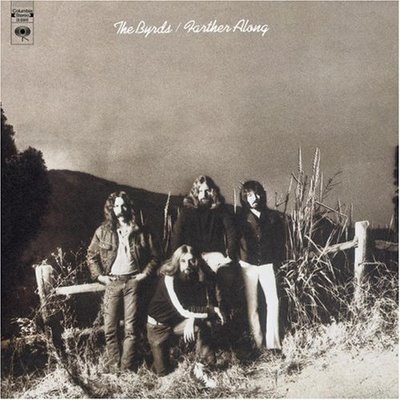
The Byrds, Farther Along (1971)


Timing and production, they matter: I could see this ramshackle album recorded on a four-track in 1996 getting some underground traction, and I could see it slathered in Byrdsmaniax overdubs, coming out in 2007 on Sub Pop as a Fleet Foxes opening act. Recorded near-live in 1971, right after the aforementioned flop, it too wilted on the vine. If not a lost masterpiece, it still deserved better, as Gene Parsons and Clarence White really showed themselves the center of the group, Roger McGuinn overcame his lifelong songwriting stupor to kick things off with the self-penned chugging 50s-style riffage of “Tiffany Queen” (one of the most overlooked Byrds gems, with even modestly clever lyrics from Our Man of the Norman Vincent Peale Reading Club), and the wretched Skit Battin/Kim Fowley songwriting duo pushed their obnoxiousness into relative remission here. We even get a moving dead-dog tribute.

Probably this was all they had in them and it’s just as well the road ended here (it’s the final LP in the organically continuous life of the Byrds, with the 1973 original-lineup return a reunion rather than a next-album). But the thing deserved better than the critical and commercial neglect it received—even the bonus tracks on the CD reissue kinda kill it.  


Saturday, June 1, 2013

The Byrds, Byrdmaniax (1971)


The near-universal consensus is that producer Terry Melcher killed this album by drowning it in sickly sweet strings and horns. Which gives him both too much and too little credit; okay, he lays it on thick, no question, but this was bound for mediocrity no matter who tweaked the knobs. Nothing could polish these tunes into gold, nor does Melcher entirely stifle what is there; McGuinn’s gentle but simple “Kathleen’s Song” was going to be endearing but forgettable whether or not swirling symphonic fills were crammed into its open spaces.

That and the Gene Parsons co-write “Pale Blue” are the fearless leader’s most—only—valuable contributions (the less said about his faltering stab at political commentary, “I Wanna Grow Up To Be a Politician,” the better; on his go-to co-composer Jacques Levy, let even less be said). Team Battin/Fowley can’t compete with even that, turning in more of the lazy pap that marked Battin’s Byrdsian contributions. Clarence White moves behind the mic for a few songs, credibly enough, though surely even the young Jackson Browne had better offerings for him to cover than “Jamaica Say You Will.”


At least they were smart enough to leave off the once-requisite Dylan cover that traded in and simplified the complicated sneer/sorrow combo of “Just Like a Woman” for a more straightforwardly sentimental version that thus missed the point.  Otherwise, all the markings of a slapdash contract filler are here, including the goofy, unappealing cover and title. Ladies and gentlemen, this is what uninspired journeyman rock music feels like.