Showing posts with label Gram Parsons. Show all posts

Tuesday, March 18, 2014

Gram Parsons with the Flying Burrito Bros, Live at the Avalon Ballroom 1969 (2007)


The first impressions of this 2-disc set effectively cancel each other out: Amoeba has outdone itself with lovely packaging, full of great archival photos and two short essays, one a loving recollection of Parsons and the Burrito Bros by Pamela Des Barres, the other a nicely detailed recounting of digging through the Grateful Dead archives (for whom the FBB were opening) for these tapes, and then the desperate quest to secure rights, by Dave Prinz. But then, that title: I’m hardly here to demand a place on the marquee for Michael Clarke, but it simply misrepresents things—as the opening audio itself makes clear—to credit this to Parsons and reduce the FBB to a supporting band. For a release so committed to musical history, that’s an unfortunate concession to (admitted) market realities, and a bit of an insult to (perhaps overly sensitive) listeners.

Well, there’s also music here—though mostly, nothing crucial from the two (April 4 and 6) very-similar live sets that replaces any LP versions. The real treasures are the two demos on disc 1, especially a spare, heartbreaking “Thousand Dollar Wedding.” "Nothing crucial" doesn't mean unworthy of a listen, though--learning the story of the "old boy" line from "Hot Burrito #1" while hearing it is worth a sniffle or two. 


Friday, February 7, 2014

Gram Parsons and the Fallen Angels, Live 1973 (1982)


Tuesday afternoon in Long Island: Gram Parsons and crew show up at the local radio station, play a live set, then head on to Philly. Probably nobody involved would have ever thought of it again, but a decade later some suit sees green, and presto: posthumous live album. Nothing here supersedes LP versions, though a sparse “Love Hurts” lets the Gram-and-Emmy duet vocals run the show, without the distraction of lead guitarist Jock Bartley, building some cred as a Fallen Angel before shaking it for soft-rock lucre in Firefall (and thus constituting one more node in the dense web of Byrdsian connections of 70s rock). All too often, Bartley drenches songs in what wankers used to call “hot licks,” but the more restrained takes, such as “The New Soft Shoe,” can be lovely. Parsons’s demeanor ranges from diffident to dickish in his banter, and he doesn’t seem particularly enthused to be there; the tired toursong “Six Days on the Road”—which the Parsonsless Burrito Brothers were also playing at the time—might be the truest thing here.

So, hardly revelatory, but no album with Emmylou Harris has ever been less than listenable.


Sunday, November 3, 2013

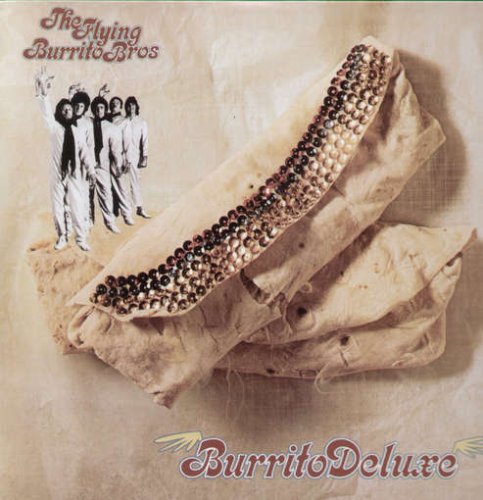
The Flying Burrito Bros, Burrito Deluxe (1970)


Less heavy-handed than the debut, it also weighs less, sometimes threatening to float away into jangly pop-rock—which is fine with me; frankly, I wish Parsons and Hillman both had taken more interest in that side of their work. GP had been kicking “Lazy Days” around for years before putting it on record here, and it sounds it—if Gilded Palace of Sin strove for the strains of 1938, this one eases into those of 1967. “High Fashion Queen” is sneering but effective, though the FBB—bros indeed—wallow in garden-variety rock misogyny that includes a zippy cover of Dylan's "If You Gotta Go," not one of his more charming moments.


They beat the Byrds to “Farther Along” by a year, though the two versions are largely interchangeable, and Parsons fumbles slightly on the closing “Wild Horses,” failing to bring Jagger’s depth of longing. Still, this brief excursion into a sort of power-pop country charts a direction not otherwise taken for this group--when Hillman dug "Down in the Churchyard" back out several years later on a solo album, it lumbered in at twice the length and half the impact. 

Saturday, October 26, 2013

The International Submarine Band, Safe at Home (1968)


In which Gram Parsons discovers country music and gives it a dry run before offering it up to the Byrds. As a songwriter, he’s got something, though at this point it’s still more promise than materialization. As a singer, he’s holding back, not quite sure how far to take this game. Brevity pays off—at just under a half-hour, it would be pretty tough to overstay its welcome, and it’s not unwelcomed to begin with. It might all peak with “Blue Eyes” at track one, but the “Folsom Prison Blues/That’s All Right” medley is my secret key to the entire Parsons project: instead of wanting to be Johnny Cash or Elvis specifically, he just wanted to iconic, period. Probably could just as well have been Sinatra and the the New Soft Bobby-Sox, so all things considered, lucky how the pieces fell here. I’d hate to think of the Byrds gone Rat Pack.

Friday, October 25, 2013

Gram Parsons, Grievous Angel (1974)


Widely considered sacrosanct, and I can see why, for about half of it. Just under, really; already thin at nine tracks, about half the running time is sheer padding. I like Tom T. Hall more than most people, but Parsons’s take on his “I Can’t Dance” is a preview for a Grounded Burrito Bros album nobody wishes existed. “Las Vegas,” well, speaks for itself. “Love Hurts” is better than the Nazareth version, but mostly because of Emmylou Harris, who admittedly improves everything she sings on.

But the core of the album is the Parsons originals. Most of them—“Brass Buttons,” “In My Hour of Darkness,” “Return of the Grievous Angel”—have a purity and simplicity that makes them near-staggering, but also suggests they were the end of the road; you can’t get much more elemental than this. “$1000 Wedding,” on the other hand, shows some narrative flair that would never be further developed.


He peaked with GP, and all indications here are of a talent all too eager to squander itself—we hear the squandering in each wasted filler track. Too bad he was so casual about his occasional ability to achieve majesty.

Saturday, September 28, 2013

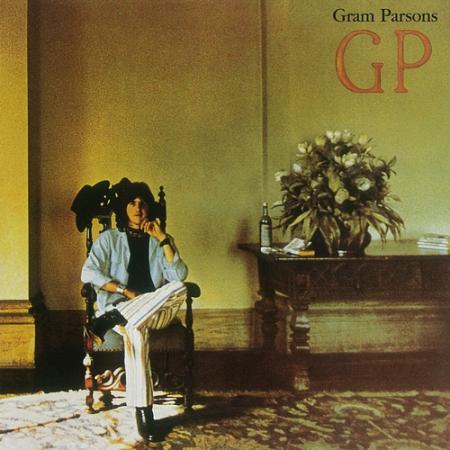
Gram Parsons, GP (1973)


It’s taken me nearly two decades to finally recognize the beauty of this album. I always had reasons, often fumbling music-crit rationalizations (about the unused well of emotion he refused to tap into because of his formalist embrace of artifice, say; or some intellectual rotgut about the inverted catch-22 of the self-applied beautiful-loser trope as a defense mechanism that undermined its force; or etc.). What it came down to, I now think, now that I finally consider this one of the finest post-Byrds records, is simply that I found Parsons distasteful, a smirking trust-fund folkie jerk with an idiotic self-mythologizing death wish.

Well, he was. And he got it. And it has nothing to do with the power of this album. Was it the 40th spin of “Kiss the Children”? A solitary midnight stroll to the strains of “The New Soft Shoe”? I have no idea, but suddenly, recently, it hit me: this is freaking great. It really is. How I never heard it until now baffles me, but there it is: a conversion narrative GP himself might appreciate, all wasted years and then redemption. And when you play “A Song for You,” I finally concede, there ain’t a smirk to be heard in all that plaintive longing. Tragic, the whole damn thing. 


Thursday, May 2, 2013

Gram Parsons/The Flying Burrito Bros., Sleepless Nights (1976)


For twelve songs squeezed out of a corpse, this isn’t half bad. Nine outtakes from the original Burrito Bros lineup in 1970 with Chris Hillman and the reliably dull Michael Clarke, and three Grievous Angels leftovers done with Emmylou Harris. It’s hard to ever dislike the Gram-and-Emmy Show—songs come and songs go, some better than others, but the two of them singing together sounds great regardless. There’s not an original composition in the bunch, but it’s freeing to hear GP stop striving for iconic status—always my least favorite aspect of his work—and just honky-tonk unto oblivion. Plus, the songs are well-chosen; why stop with one Merle Haggard tune when we can have two, the second of which is the perfectly plaintive death-row lament “Sing Me Back Home,” the album’s highlight? Otherwise, nothing here achieves classic status, but most of it falls just short. In a pinch, I’d probably take it over Grievous Angel.  


Friday, March 15, 2013

The Flying Burrito Bros, Gilded Palace of Sin (1969)


Venerated as this album is, I’ve always found it a little stiff, too much a formalist exercise. Gram Parsons wholly subjugates Chris Hillman to his project, but rarely conveys any depth of feeling; “Hot Burrito #1,” one of the few exceptions, comes too late. Likewise, when the band finally unclenches on “Hot Burrito #2,” a weight lifts and some actual air seeps in at last.

Lest this sound harsh, it is, no question, good stuff; ontological status of its authenticity notwithstanding, “Sin City” is simulacra Jean Baudrillard himself would admire, rockist tropes be damned. But the group is best when it stops feigning anachronisms and embraces topicality, as on the draft-evading “My Uncle,” which basically sounds like . . . well, the Byrds (although the less said about the closing atrocity “Hippie Boy,” the better).