Showing posts with label David Crosby. Show all posts

Thursday, November 20, 2014

David Crosby, Croz (2014)


“I have a dream, a great man said/another man came and shot him in the head”: such is what passes for wisdom in the lyrics of a decaying man-child. I blame this album for singlehandedly derailing my effort to get this blog back off the ground, many a month ago; I checked it out from the library, renewed it, renewed it again, and just could not bring myself to play the damn thing. Finally I uploaded it to my iPod, returned it, and forgot about the whole affair until, months later, trapped on a crowded bus crawling east across Los Angeles from Westwood to downtown at rush hour the other week, I figured life couldn’t get much worse and it was thus the perfect time to pull the trigger.

Well, Croz is not worse than it promised. It might even be the perfect soundtrack for a slow-motion death-march through Beverly Hills and West Hollywood. I’m not sure DC himself knows what decade it is, mentioning “static and hiss” on “Radio” as if he hadn’t heard about that durn digital thing. Or maybe he does know the score, but just really needed to find that challenging rhyme for the previous line’s “this.” It’s not all monosyllabic simpleton lyrics, though, as he strives for the highfalutin platitudes that have marked his work since it first began defacing Byrds tracklists; “fear is the antithesis of peace,” the Croz decrees on “Time I Have.” Man also has cranky things to say about city life. Truly, it is all mind-numbingly abysmal, dragged along by aimless guitar noodling, silly two-finger solos occasionally bending a string over plodding chord-strums (Mark Knopfler guests, but with the vim and vigor of Ghostface obliging Inspectah Deck with a guest verse, clearly saving the A-game for his own work), half-awake pseudo-jazz drumming, and bored-session-player bass (probably the most solid part). There’s an almost-okay song in the subdued acoustic wistfulness of “Holding on to Nothing,” during which DC nearly bothers to construct a melody, but otherwise everything here is bloated, pointless, stupid, and grating. At least Stephen freaking Stills has the decency to just live in the perpetual past.


Friday, September 5, 2014

Crosby, Stills, and Nash, Demos (2009)


Greg Demos is a god of rock. Dude is old, wears tight leather pants, wipes out on the Letterman show like it ain't no thang, and throttles his bass like someone living the dream, not going through the motions (ahem, Messrs. CS&N).

In my fantasy version of this album, Demos joins the three crusty old fogeys and shakes something loose, something vital and vibrant and raunchy, like the opposite of Rick Rubin ossifying geezers into statesmen, and they all bash out a bunch of garage jams like the Byrds were secretly just the Troggs with some jangle all along.

Alas, this is not my fantasy LP. It is all too literal demos. So we get these songs stripped down, back in ye olden times, shorn not only of full arrangements but even of the harmonies that were the only thing ever making CSN conceivably worthwhile. Thus we see the songwriting sinews of “Almost Cut My Hair” and “Marrakesh Express,” but anyone listening to those songs for the songwriting has a vastly different, and incomprehensibly sadder, understanding of music from me.

“Love the One You’re With” had a different melody originally, that’s almost interesting to note. Otherwise, a total wash. Fewer demos, more Demos.


Friday, January 24, 2014

The Byrds, Preflyte (1969)


I know their artistic ambitions aspired to ever loftier terrain, but I like the Byrds* as a simple pop band, which is exactly what Preflyte delivers. Recorded in 1964, when they were just five cute, goofy young men posing on the back cover with rifles (Gene Clark, unarmed and pensive, hides behind a scrawny tree, naturally), but leaked only in '69, this delivers eleven songs in 25 minutes, only one topping 2:30, and then by a mere second. Some are dry runs for album tracks, and none are holy grails of lost song, but “You Showed Me” reclaims a McGuinn/Clark composition from its better-known Turtles hit, and Gene Clark has never rocked as unselfconsciously as he does on “You Movin’,” surely the most Beatles-dance-party song he ever wrote. I can imagine the older, wiser, sadder Clark sneering at it, but for two shouted, stomping minutes, it’s the best thing in the world.

* I only just noticed that the only place the Byrds are actually named on this LP is in the liner notes--not on the cover, side, or record itself. So technically it should be credited to Jim McGuinn, Gene Clark, David Crosby, Chris Hillman, and Michael Clarke--but to hell with that. 

Saturday, November 23, 2013

Crosby, Stills, Nash, & Young, Wooden Nickel (1969)


No sense rehashing my grievances with the main characters here—Crosby and Stills remain unbearable egomaniacal prigs, Nash a bobbleheaded proto-himbo, and Young the only real songwriter of the bunch (albeit also something of a hippie meathead, just a really talented one), so that’s off my chest.

Bootlegged at Big Sur, this seems to circulate in pricy but cruddy faceless vinyl. I scored a five-dollar copy at South Philly’s Beautiful World Syndicate, and will say this: within the constraints of the group’s insufferability, it’s a strong document. Audio purists might wince at a version of “Suite: Judy Blue Eyes” that sounds like a 90s lo-fi 4-tracker, but to me, it’s a step in the right direction from the pointlessly airless studio perfectionism of the album take. And fortunately, Young takes over the running length—his first-side “Birds” is loose (“close enough for jazz,” as he puts it) and wondrous, and then on side two, he elbows the geezers out of the way for a 19-minute “Down By the River.” Sure, Crazy Horse did it with more muscle, but the thought of a pouty Crosby and Stills sulking because nobody’s paying any attention to them (they add nothing to this song) more than compensates.

Saturday, November 16, 2013

David Crosby/Graham Nash, Whistling Down the Wire (1976)


Cultural historians of the future will have a tough time explaining 1970s rock stardom. Did it depend on songwriting skill? Musical virtuosity? Charm? Good looks? Crosby & Nash defy all of the above; they plod along inexplicably, dropping LPs with no legitimate grounds for existence. Like this one: Nash continues to strain for poetry and profundity, consistently achieving neither (he’s clearly been listening to frenemy Neil Young, but just can’t get it right; “And the cannibals are waiting on the edge/to eat the meat that they can smell” is just . . . dumb), while Crosby churns out more vaguely song-like temporal chunks of sound. The best moments come in spite of the nominal figureheads: when Crosby finally shuts the hell up on the wordless “Dancer,” or when “Mutiny” achieves a second-class Steely Dan sound that nearly drowns out Nash’s insipid lyrics. I remain baffled by this entire phenomenon. 


Monday, August 5, 2013

The Byrds, Younger Than Yesterday (1967)


Probably the only album in rock history in which a band recovers from a 3rd album slump by having the bass player take the lead songwriting role. What’s amazing is that Chris Hillman, for one record and one record only, very nearly fills Gene Clark’s shoes. “Have You Seen Her Face,” “Time Between,” Thought and Words,” they just roll out so seemingly effortlessly, pop-rock manna from four-string heaven. Throw in the slightly lesser (but still wonderful) “The Girl with No Name” and the Hillman/McGuinn co-written opener “So You Wanna Be a Rock ‘N’ Roll Star,” and this is Hillman’s greatest moment, a triumphantly jangly revitalization. Like floating garbage lifted by a rising tide, even David Crosby writes an actual song for once with “Renaissance Fair,” perhaps his finest turn.

This was probably the end of the line for this particular style of music; by the next year, you’d have to up your artistic ambitions or become the Monkees. It’s a delightful departure (I’m just gonna keep pretending Crosby’s “Mind Gardens” never happened).


Wednesday, July 24, 2013

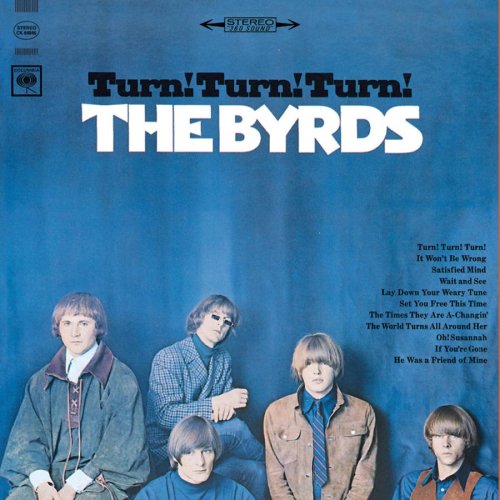
The Byrds, Turn! Turn! Turn! (1965)


Second verse, same as the first—to diminishing returns, but only slightly so. We still get revved-up Dylan covers (there’s no “please” in their command to get out of the new road in “The Times They Are A-Changin’”); splendid Gene Clark originals, all moody and brooding and yet possessed of lovely pop melodies; and scattered accoutrements that range from Porter Wagoner country hits to a few McGuinn stabs at pop-rock that aren’t half bad, the Herman’s Hermits to Clark’s Dylan-by-way-of-the-Beatles.

Nothing here is as game-changing as “Mr. Tambourine Man”—what within the Byrds framework could ever be again?—but the album takes on complicated (and problematic) weight as a last dying gasp of the American Camelot myth. The title track’s plea for peace would sound more desperate than prescient soon, and the expunged minstrel past of closing “Oh! Susannah” was a national repressed that was already returning (I won’t even go on a diatribe about Cold War bully John Kennedy, mourned in “He Was a Friend of Mine”; I’ll just sub in a link to Stephen Rabe’s compelling book The Most Dangerous Area in the World: John F. Kennedy Confronts Communist Revolution in Latin America). Anyone who takes this thing as pure simple pop music either votes Republican or hasn't listened very closely.

For all that baggage, and despite inexplicably leaving a few worthy Clark originals on the cutting room floor (“The Day Walk” is quite a loss), the thing hangs together, tenuously and anxiously jangle-rocking on the edge of oblivion. It already was too late, but maybe that was the point.


Tuesday, June 11, 2013

Crosby/Nash, Live (1977)


Graham Nash’s “Simple Man” followed by David Crosby’s “Foolish Man” at the start of side 2 here summarizes the intertwined careers of these buffoons better than any belabored snark possibly could. There are probably less essential albums out there—Rednex’s 1994 Sex & Violins comes to mind, though even Whale’s 1995 We Care just barely avoids the classification, “Hobo Humpin’ Slobo Babe” and all—but few less interesting ones. This just plods along, not even bothering to grab for the duo’s grade-A material, whatever that might be. If four minutes of Nash’s “Mama Lion” seems interminable, that’s only because you haven’t yet reached the epic closer, nearly ten excruciating minutes of Crosby’s orgy-of-idiocy “Déjà Vu.” 

Sunday, May 19, 2013

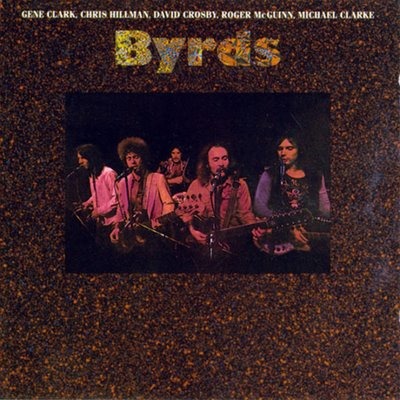
Byrds, s/t (1973)


The main thing a 1973 album featuring all five original Byrds (no "the" anymore, it seems) has going for it is low expectations; none of these dudes was near his prime by this point except for Gene Clark (and nobody seemed to care about him, inexplicably), so to hear this album rise to comfortable mediocrity is a pleasant surprise. That said, apparently nobody had lower expectations than the Byrds themselves, since most of them bring their scattered leftover songs rather than prime material, which they hoarded for their various solo pursuits. It’s like some unfortunate hybrid of the prisoner’s dilemma and the free rider problem.

It starts off strong, with Clark’s “Full Circle” (admittedly, recycled from his solo album Roadmaster, but given that that album only came out in, what, the Netherlands, I’ll call this fair) and another Clark tune on the first side; it’s smart enough to bury its two tuneless David Crosy atrocities on side two (one of which is also repeated, less excusably, from his own solo album of two years earlier). Chris Hillman gets two breezy little ditties that anticipate the effortlessly-forgettable Doobie Bros, and McGuinn even offers a decent folksy tune of his own (in addition to the bottom-feeding “Born to Rock’n Roll,” the sort of thing T-Rex did better but which should really not be done at all).

It’s rounded out by two Neil Young covers, bad ideas both. “Cowgirl in the Sand” comes at its most un-rocking, McGuinn’s claims notwithstanding, and while I understand the impulse to cover “(See the Sky) About to Rain,” truly one of the most beautiful songs in the Young songbook, not even Clark's vocals can top Young's own, and the band plays watered-down soft rock.

Why the back cover so emphasizes Hillman's splayed crotch, that I cannot say. 


Thursday, May 16, 2013

Crosby, Stills, Nash, and Young, So Far (1974)


Has a cash-in ever been as cynical as this greatest hits that consolidates all two studio albums and two non-LP tracks, one of them a piddling Stills effort? I blame David Crosby. Shameful. 

Saturday, May 4, 2013

Crosby Stills Nash, Live It Up (1990)


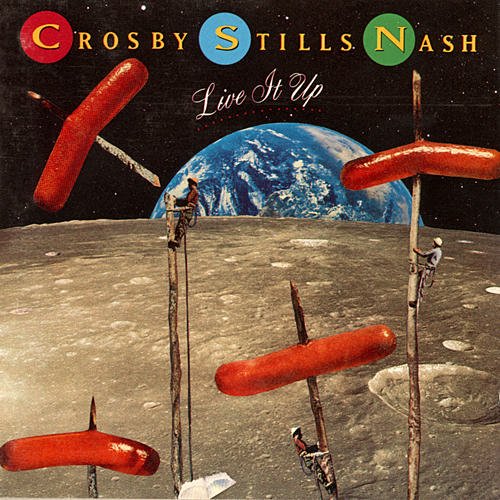
From the very first sounds, several thwacks of a reverb-drenched drum leading into some limp synth vamping, Live It Up is such a sad embarrassment that you almost, almost feel sorry for these poor desperate fools. They’re so washed up that they farmed out much of the songwriting to a bunch of anonymous hacks and hangers-on, and when Stills does deliver a composition at track three, you immediately wish they’d just admitted defeat and brought Desmond Child onboard. A quarter-century of wealth and fame, and here’s what Stills has to say: “Tomboy, always with the wrong boy/You need a strong boy, Tomboy, Tomboy.” She also shoots pool, and –wait for it, I quote verbatim—“got a heart of gold.” For shame, man.

Crosby’s accumulated wisdom isn’t much better—let’s see, it’s bad when teenagers in Ireland suffer, and he “don’t care what has got you down/You can turn it around.” Graham Nash just fades into the backdrop, an anonymous voice singing anonymous songs, and there’s nothing to say about the sound of the album beyond the fact that it consists of stale aping of already-retrograde sonic trends (for comparison: the Damn Yankees’s debut came out this same year, and sounded vastly more relevant). Every one of the ten tracks is a dull, plodding, soulless fiasco; offhand I cannot think of a worse record by a washed-up 60s group striving for relevance. The single meager positive thing to be said of this is that its goofy hot-dogs-on-the-moon cover is better than some of the poor visual choices Joni Mitchell was making around this time. Otherwise, an absolute zero all around.

Friday, April 26, 2013

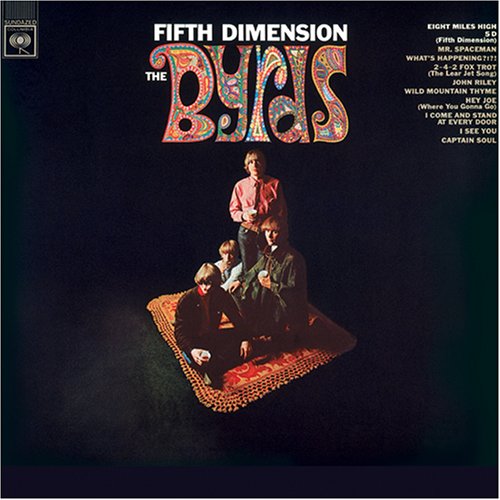
The Byrds, Fifth Dimension (1966)


When Roger (then still Jim) McGuinn explained in a 1965 interview that the Byrds were modifying folk music to “meet the nuclear expansion and jet age,” it sounded like a brilliant summation of the Zeitgeist. It turned out he just wanted to sing songs about airplanes; “2-4-2 Fox Trot (The Lear Jet Song)” here is just the first of many to follow. In its limp lethargy, it’s far from alone; I wouldn’t be the first to call Fifth Dimension a killer single with ten b-sides. If “Eight Miles High” was a departing gift from Gene Clark, his generosity was somewhat wasted. As the most heavily McGuinn-composed Byrds album to date, this reflected the hole at the center of the group. McGuinn has perilously little to say, and even padded out with covers and traditionals from “Hey Joe” to “John Riley,” the strain shows (his opening “5D (Fifth Dimension)” sounds like a Dylan cover, except with mushy roundabout lyrics). It could be worse, though—David Crosby’s debut solo songwriting credit “What’s Happening?!?!” anticipates decades of blathering pseudo-profundity from the insufferable Beat-aping man of boundless ego, but at least someone was smart enough to leave his equally tuneless “Psychodrama City” an outtake.

Credit where credit is due, though: McGuinn the songwriter ain’t much to marvel at, but his Coltrane-influenced guitar work, tested out a bit on “I See You” and then given full airing on “Eight Miles,” remains mindblowing. If only he had gone into some jazz-wonk underground instead of the bland rock that rendered him inert after this, unto eternity…


Thursday, April 25, 2013

Crosby, Stills, Nash & Young, 4 Way Street (1971)


It’s hard not to appreciate the sheer rockstar dickishness of opening this double-live album with a purported “Suite: Judy Blue Eyes” that runs 30 seconds, most of it background noise. Plus, it gets the song out of the way right quick to make way for Young’s “On the Way Home.” That Y towers over CSN as always is barely necessary to mention, but the formless bloat of the C songs are handled as gracefully as possible, by lumping a few together early on and dispensing with them thus. Stills, as always on live recordings, absolutely murders his songs—not in the hip-hop style of killing it, but as in, mangles and abuses them until they are lifeless sonic corpses. Truly, the man’s stage presence is nil, and that the album ends with nearly 20 minutes of him would be unbearable if a decent chunk of that were not messy guitar clanging with Young. Nash, always more pretty than smart, at least gets a dig in at Mayor Daley on “Chicago,” and if it’s obvious, well at least it’s not as wrongheaded as some of his songs about Vietnam vets and whatnot. Really this would be best served by extracting the Young songs, appending them to Live at Massey Hall 1971, and leaving the other three to fend for themselves (they’d actually sound better without Young there to put them to shame so constantly)—but all that being said, they do harmonize nicely, and it’s worth it for that.


Monday, April 22, 2013

Crosby, Stills & Nash, Daylight Again (1982)


To be fair, this album is less terrible than one would be justified in fearing; for two tracks in the middle of side 1, it achieves a decent groove (even if Stills strains so hard for anthemic weight on “Southern Cross” that gives himself an REO Speedwagon hernia). I think Nash might be going for some very un-Hollies-like Foreigner-style riffage on “Into the Darkness”; Crosby opens “Delta” with “Waking/Stream of consciousness,” never a promising sign—but fortunately he’s otherwise held in abeyance. Stills largely hijacks side 2 and runs it into the ground with turgid MOR rock; never one to bypass a chance to relive past (pseudo-)glories, he ends things with an idiotic glommed-on revival of “Find the Cost of Freedom” that drags the title track from very-nearly-evocative to sad Cleveland-rock-city-where-are-we-again? medley terrain. As usual, Nash comes off best, even when he writes such an insipid platitudinal greeting-card of a song for his wife that you briefly wonder if it was really some sort of passive-aggressive insult.

I do love the album cover, no kidding.

Thursday, April 18, 2013

Crosby, Stills & Nash, CSN (1977)


Truly, would it trouble Stills or Crosby so much to write actual songs? Their formless, lifeless tunelesscapes drone on interminably, then crawl away without leaving much but the sticky residue of their insufferable smugness; park bench mutations, indeed. The beneficiary here is Nash, whose trite simpleton songs at least bother to gesture at things like melody (though dropping acid in Winchester cathedral, however personally transformative it may have been, hardly makes for compelling song fodder; way to go, Graham, nobody did anything that wild and crazy in the 70s). At least it ends with Stills riff-rocking a bit on “I Give You Give Blind”; it would be better as a Neil Young jam, but generally speaking, the more and/or louder guitar, the relative less overt Stills presence--always for the better.
Still, you could listen to this album, vote for Gerald Ford, and feel no cognitive dissonance. 

Monday, April 15, 2013

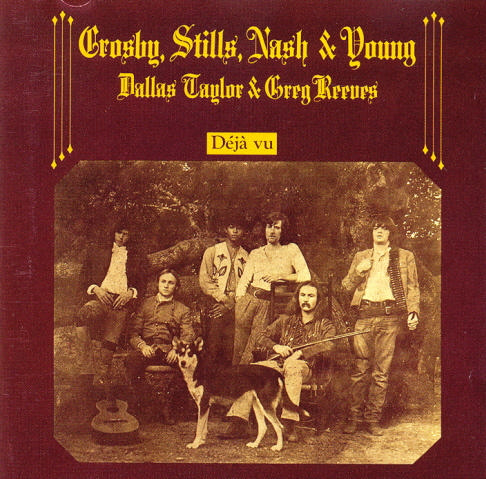
Crosby, Stills, Nash & Young, Deja Vu (1970)


My theory as to why this album towers so high above most everything else C, S, and N ever did: the gravitational pull of four gigantic egos held everyone down to earth for once (more or less: Crosby can’t resist one aimless pseudometaphysical sonic quagmire on the title track) and the competitive spirit when each one only got a few songwriting at-bats meant all killer, no filler—there’s no space on the record for the latter. Crosby might think almost cutting his hair is an event as important as the civil rights movement, but it’s better that he sticks to the smaller topic, and the musicians around him burn and slash through his self-absorption anyway. Nash spends his two tracks on domesticity, but for once his vapidity took on topicality in the historical moment, and the buoyant melodies help. Stills seems to have tried revising his songs for once instead of just thought-vomiting them straight out; it helps, too. And Young, who could never be contained by these milquetoast clowns for long, delivers some quivering beauty on “Helpless” and then pretends Crazy Horse is around with some garage-stomp to close things out. It all holds together better than it could ever deserve to.

Wednesday, April 10, 2013

Crosby, Stills & Nash, Allies (1983)


While the early 80s fell like an asteroid on most classic-rock dinosaurs, I’m kind of partial to Stills' “War Games,” perhaps because at 2:18 it’s a nice zippy respite from the crushing bloat of these guys’ typical songs. Mostly-live Allies has almost nothing else to offer—Graham Nash doesn’t like nuclear weapons or pollution, and wrote some bad songs to prove it—but at least the drugs keep Crosby largely sidelined. Nash’s “Wasted on the Way” is a pretty self-satisfied taking-stock song from a guy who can’t keep his asshole bandmate off the smack and has to resort to padding albums out with half-decade-old live cover songs, but remains more forgivable than Stills’s lumbering closing rendition of “For What It’s Worth,” beaten and battered into arena-rock mush, and just horrid. Neil Young flopped this year too, but not this much; even at his goofy worst, he still towers over these gasbags.   

Saturday, March 30, 2013

The Byrds, Mr. Tambourine Man (1965)


However obvious it sounds in retrospect, the fusing of Dylan and the Beatles was modern rock’s Cartesian moment (and for what it’s worth, cogito, ergo sum seemed pretty self-evident after the fact too). The LP never sounds like an historical artifact, either—forty years after the fact, it still exudes an uncontainable energy. So many genealogies begin here; McGuinn’s jangling guitar bequeathed Peter Buck and indie rock as we know it, and even Michael Clarke, never the world’s greatest drummer, brings a striking visual cool, all t-shirts and eyes buried under hair and sullen lips, looking like nothing so much as a young Thurston Moore. 

The real secret genius, though, is Gene Clark; any band can cover Dylan, but few could deliver originals like his. Bashing out one perfect pop gem after another, he makes it sound easy, so that when the bridge on “You Won’t Have to Cry” threatens to climb a step into straight-up wanna-hold-your-hand-ness, it’s possible to read it as a sophisticated joke rather than aping and have some ground to stand on. Maybe it’s both. Either way, “I’ll Feel a Whole Lot Better,” “Here Without You,” It’s No Use,” etc.: ten of the album’s twelve tracks (and all of the originals) clock in under three minutes, often well under (Dylan's "Spanish Harlem Incident" was short; theirs is shorter by 20%, not even two minutes long!), reflecting an intuitive awareness of pop mechanics at their finest; crawl into the ear, get out quick, and leave a lasting earworm. Every single Clark composition is A-side material, every single cover an assertive act of ownership. The American rock LP nearly peaked here, at its birth. 

Friday, March 29, 2013

Graham Nash/David Crosby (1972)


One of the bigger shocks of my recent vinyl-digging adventures has been the resolute mediocrity of Graham Nash’s solo work; I have such positive Hollies associations in my head that I expected more than his trite and fairly tuneless solitary efforts. At least he writes actual songs here, with a few, like opener “Southbound Train,” even rising above the moon/June/spoon template so familiar from his solo LPs. That’s in contrast to Crosby, who continues to warble idiotic sweet nothings over barren soundscapes that never once resemble a verse, chorus, melody, or iota of songwriting aptitude, all the while thinking he’s some sort of countercultural shaman or something. The man’s utter fraudulence is so risible that I can’t play this without ranting to anyone nearby, even if it’s just the cats. I'm pretty sure they hate Crosby, too. 

Sunday, March 24, 2013

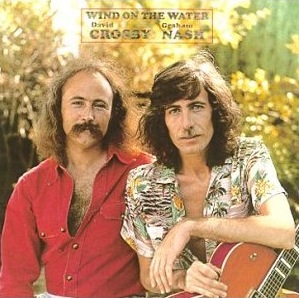
David Crosby and Graham Nash, Wind on the Water (1975)


The relentless crapulence of post-Byrds albums in general, and the sheer offensiveness of David Crosby’s horrid artistic persona in particular, have engendered a certain sourness on my part that can slide into preemptive scorn for these records. So it's through somewhat gritted teeth that I confess, this album isn’t really half bad. In a rare gesture, Crosby awakens from his lifelong stupor to kinda, sorta write actual songs, and as always Nash sounds decent enough as long as you don’t pay more than half-attention. Nothing sticks out, but nothing grates, and what really proves the album’s low-intensity non-failure is that two-part closer “To the Last Whale” somehow manages not to be the abysmal wreck that title very much demands—but then I also like Star Trek IV and even Yes's "Don't Kill the Whale," so there may be a soft spot here I never realized I had.