Showing posts with label Gene Clark. Show all posts

Saturday, March 1, 2014

Dillard & Clark, The Fantastic Expedition of Dillard & Clark (1968)


The Byrds all went rustic concurrently in the late 60s, despite being apart. Unsurprisingly, Gene Clark did it best; while the remaining official-Byrds began strip-mining the past for inspiration, Crosby rotted away on a farm with CSNY, and the Burrito Brothers only slowly eased into place, the best songwriting, melodies, and singing were all to be found here—naturally, in the shadows of all those albums, in terms of public profile.

It is a literal expedition—down to New Orleans, from Memphis to Colorado, crossing into San Bernardino (in the restored outtake “Lyin’ Down the Middle”)—and unlike the space-age flight fixations of Roger McGuinn, Clark still travels the old routes; “Train Leaves Here This Morning” is both song and entire worldview. He drifts from one heartbreak to the next, and if it’s not quite as sorrowful as subsequent solo albums, Dillard’s ace picking and strumming has a lot to do with it. Clark is in righteous form as always, forlorn until he tears it up on a (non-LP) “Don’t Be Cruel” that sounds like an instruction manual for Gram Parsons, who wished he could do this (and whose fellow Burritos pop up, including a mini-Byrd reunion with Chris Hillman and Michael Clarke). It’s hard to believe these are nearly all originals—they whisk by in under a half-hour, sounding effortless and timeless. 


Friday, January 24, 2014

The Byrds, Preflyte (1969)


I know their artistic ambitions aspired to ever loftier terrain, but I like the Byrds* as a simple pop band, which is exactly what Preflyte delivers. Recorded in 1964, when they were just five cute, goofy young men posing on the back cover with rifles (Gene Clark, unarmed and pensive, hides behind a scrawny tree, naturally), but leaked only in '69, this delivers eleven songs in 25 minutes, only one topping 2:30, and then by a mere second. Some are dry runs for album tracks, and none are holy grails of lost song, but “You Showed Me” reclaims a McGuinn/Clark composition from its better-known Turtles hit, and Gene Clark has never rocked as unselfconsciously as he does on “You Movin’,” surely the most Beatles-dance-party song he ever wrote. I can imagine the older, wiser, sadder Clark sneering at it, but for two shouted, stomping minutes, it’s the best thing in the world.

* I only just noticed that the only place the Byrds are actually named on this LP is in the liner notes--not on the cover, side, or record itself. So technically it should be credited to Jim McGuinn, Gene Clark, David Crosby, Chris Hillman, and Michael Clarke--but to hell with that. 

Saturday, August 3, 2013

Gene Clark, Silverado ’75: Live & Unreleased (2008)


In classically Clark-like fashion, I set myself up for a fall here: so excited was I about the idea of No Other tracks rearranged for live performance that I saved this album for a solo drive across upstate New York. Outsized romantic visions of Gene Clark melancholia accompanying the setting sun over Ithaca were just not matched by what often seemed like a honky-tonk one night stand; “Long Black Veil” is a great song, sure, but what is doing as the opening track here, when this guy wrote so many gems?


So I set Silverado ’75 aside for a year, chalking it up as a disappointment. Returning to it now, unburdened of its road-trip duties, it plays better: the thing is a honky-tonk two night stand, after all (sharing a Denver bill with Tom Waits; if only they’d collaborated!), which is about all Clark could hope for after the unjust commercial failure of No Other. The Byrds songs have an added layer of sadness, and the test runs for songs from the next LP fit comfortably alongside the older tracks and some standards--surely credit here goes to his tight touring band of Roger White and Duke Bardwell (trading off between low-rent Clark gigs and huge Elvis ones at the time). And while there are only a bare two songs from the album that theoretically undergirded the tour, both the title track and set closer “Silver Raven” both withstand being stripped down to their core components; shorn of the studio dressing, they’re not necessarily more intimate but they are more revealing of Clark’s songwriting strengths, never lost on record but always jostling for the foreground with the sonic accoutrements.

Ultimately it's mostly a verite documentary of what it was like to be Gene Clark in 1975: constrained to play songs that make folks swing their hips a little rather than the sweeping epics he had just recorded, sounding alternately checked-out and deeply moving, and probably wondering why 1975 seemed so much smaller than 1965. 

Wednesday, July 24, 2013

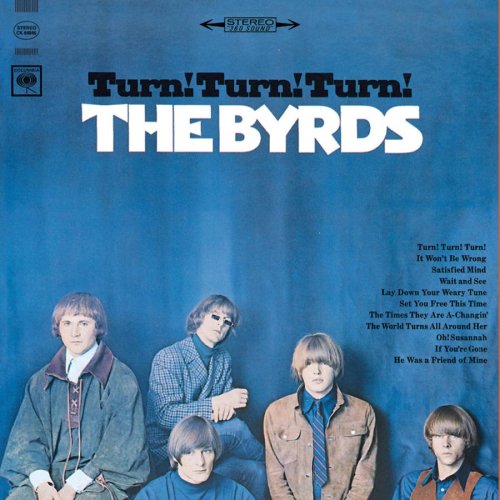
The Byrds, Turn! Turn! Turn! (1965)


Second verse, same as the first—to diminishing returns, but only slightly so. We still get revved-up Dylan covers (there’s no “please” in their command to get out of the new road in “The Times They Are A-Changin’”); splendid Gene Clark originals, all moody and brooding and yet possessed of lovely pop melodies; and scattered accoutrements that range from Porter Wagoner country hits to a few McGuinn stabs at pop-rock that aren’t half bad, the Herman’s Hermits to Clark’s Dylan-by-way-of-the-Beatles.

Nothing here is as game-changing as “Mr. Tambourine Man”—what within the Byrds framework could ever be again?—but the album takes on complicated (and problematic) weight as a last dying gasp of the American Camelot myth. The title track’s plea for peace would sound more desperate than prescient soon, and the expunged minstrel past of closing “Oh! Susannah” was a national repressed that was already returning (I won’t even go on a diatribe about Cold War bully John Kennedy, mourned in “He Was a Friend of Mine”; I’ll just sub in a link to Stephen Rabe’s compelling book The Most Dangerous Area in the World: John F. Kennedy Confronts Communist Revolution in Latin America). Anyone who takes this thing as pure simple pop music either votes Republican or hasn't listened very closely.

For all that baggage, and despite inexplicably leaving a few worthy Clark originals on the cutting room floor (“The Day Walk” is quite a loss), the thing hangs together, tenuously and anxiously jangle-rocking on the edge of oblivion. It already was too late, but maybe that was the point.


Sunday, June 9, 2013

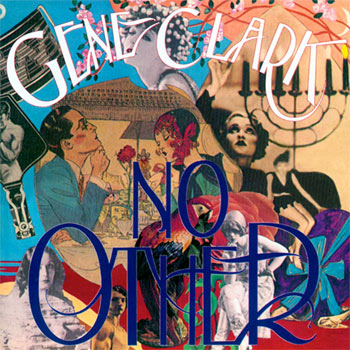
Gene Clark, No Other (1974)


Visionary maximalist psychedelic country-rock albums are hardly in abundance, with good ones more rare yet. So it wouldn’t seem like Gene Clark was tapping a goldmine here—nor did the immediate results vindicate him, with the album flopping and meeting critical disinterest.

Gene Clark was right, and everyone else was wrong. More than just the great lost Byrds-member album (and let’s face it, it doesn’t take much to rank high in this particular canon), this is one of the great lost 70s albums, period. Thomas Jefferson Kaye’s production is bombastic but genuinely exploratory, slithering funk bass and constant keyboard hum and even Chris Hillman stopping by with his mandolin all contributing to rather than distracting from Clark’s grasp for transcendence. On the lyric sheet some of it reads as mystical babbling, but the delivery sells it—when he asks, “Have you seen the old world dying,” you don’t doubt that he has, and when "Some Misunderstanding" briefly totters toward formlessness, that voice, all yearning and longing and reminding that "we all need a fix," pierces the fog and pulls it together. Even if that old world for Clark might have been his sobriety—while “Life’s Greatest Fool” and “The True One” might have fit in on his earlier solo albums (high praise indeed), closer “Lady of the North,” co-written with Doug Dillard and the only shared songwriting on the record, shows how far things have moved from the Dillard & Clark albums. This is what they might have sounded like with a symphony and a mountain of blow—accoutrements that might crush a lesser talent, and which couldn’t possibly be sustained even by Clark, but which coalesce here into eight long songs (with no conceivable radio single in sight--oh, how David Geffen must have fumed) that form one unbroken, nearly perfect, suite. No Byrd ever put out, or even played on, a better album than this.

Too bad about the cover art, though. As much as I endorse the destabilization of gender roles, the strikingly attractive Clark looks terrible in bad makeup and (I think?) drag on the back:


Sunday, May 19, 2013

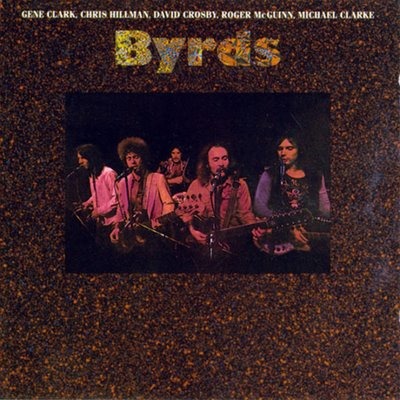
Byrds, s/t (1973)


The main thing a 1973 album featuring all five original Byrds (no "the" anymore, it seems) has going for it is low expectations; none of these dudes was near his prime by this point except for Gene Clark (and nobody seemed to care about him, inexplicably), so to hear this album rise to comfortable mediocrity is a pleasant surprise. That said, apparently nobody had lower expectations than the Byrds themselves, since most of them bring their scattered leftover songs rather than prime material, which they hoarded for their various solo pursuits. It’s like some unfortunate hybrid of the prisoner’s dilemma and the free rider problem.

It starts off strong, with Clark’s “Full Circle” (admittedly, recycled from his solo album Roadmaster, but given that that album only came out in, what, the Netherlands, I’ll call this fair) and another Clark tune on the first side; it’s smart enough to bury its two tuneless David Crosy atrocities on side two (one of which is also repeated, less excusably, from his own solo album of two years earlier). Chris Hillman gets two breezy little ditties that anticipate the effortlessly-forgettable Doobie Bros, and McGuinn even offers a decent folksy tune of his own (in addition to the bottom-feeding “Born to Rock’n Roll,” the sort of thing T-Rex did better but which should really not be done at all).

It’s rounded out by two Neil Young covers, bad ideas both. “Cowgirl in the Sand” comes at its most un-rocking, McGuinn’s claims notwithstanding, and while I understand the impulse to cover “(See the Sky) About to Rain,” truly one of the most beautiful songs in the Young songbook, not even Clark's vocals can top Young's own, and the band plays watered-down soft rock.

Why the back cover so emphasizes Hillman's splayed crotch, that I cannot say. 


Sunday, April 28, 2013

Gene Clark, Firebyrd (1984)


The hurdles here are many: synth-clouded production, apparent songwriting exhaustion on the part of Clark, the somewhat desperate-seeming gambit of opening with a new spin on “Mr. Tambourine Man,” and the album title itself, less effective in invoking his old band than in reminding us that Roger McGuinn had already engaged in low-grade worldplay with the (admittedly even worse) Thunderbyrd several years earlier.

Once he starts singing, none of that matters: weary and sad down to the core, that melancholy Clark voice pierces through the overlay of detritus and delivers a deeply felt album, drum sound be damned. Of the nine tracks, two are reclamations—the aforementioned opener and the Byrds classic “Feel a Whole Lot Better.” The synthetic accoutrements are disorienting at first—hey, this stuff is fine for the Human League, but this is the guy who gave us White Light, cripes—but again, Clark pierces the sonic veil. When he tries to elude the “twisted reach of crazy sorrow” on the Dylan song, it’s as close to an autobiographical thesis statement as other people’s lyrics can come.

Of course, there are other more obvious theses: “Rodeo Rider” uses a pretty thin metaphor of a tired cowboy on the road to express Clark’s own predicament. Again, delivery supersedes the rather facile songwriting. Clark surrounded himself with much of his old No Other crew, overlooked talents from the 70s; if Andy Kandanes hardly revolutionizes the drum kit and seems gratuitous as a co-writer on “Rodeo Rider,” the kind of song Clark would have tossed off in his sleep a decade earlier, their co-written “Rain Song” is one of the most beautiful, aching songs in the entire Clark songbook. Thomas Jefferson Kaye is on-hand for support too, offering up the brooding, ominous “Vanessa,” another highlight.

As a solo songwriter, Clark only has two new turns, one of which, “Made for Love,” is a bit cringe-worthy in its declaration that “most of all, girls are made for boys to love.” But if Gene never took Women’s Studies 101, he can still claim the authoritative take on Gordon Lightfoot’s “If You Could Read My Mind,” and Firebyrd closes with his other solo composition, “Blue Raven,” an update of the amazing “Silver Raven,” one decade of disappointment later. It leans a bit heavily on a flute melody, which goes from lovely to intrusive by the end, but as the summation of the album’s backward-looking resignation and a cataloging of opportunities lost and destroyed, it’s again sung to perfection. Clark is on a Hank Williams level of high-lonesome here, and no keyboard or drum reverb can stand in his way. Firebyrd is probably too marred to qualify for greatness, but it carries more emotional weight than anything else done by a former Byrd since his own lost classic of a decade prior.

Also, I'm not sure when that cover shot was taken (there are multiple covers for this album, which was poorly and erratically distributed), but for a guy on the verge of drinking himself to death, Clark looks remarkably good, like a cross between an early John Rechy and a proto-emo twink. 


Friday, April 26, 2013

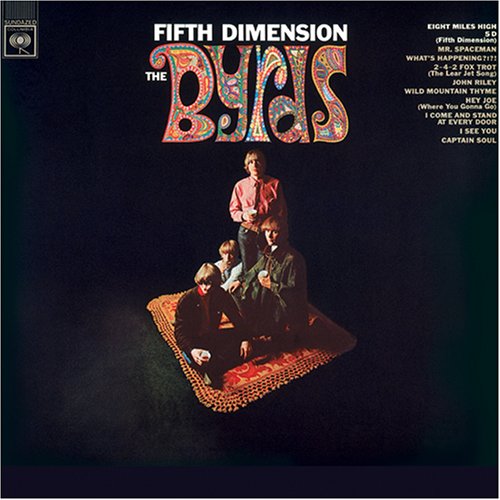
The Byrds, Fifth Dimension (1966)


When Roger (then still Jim) McGuinn explained in a 1965 interview that the Byrds were modifying folk music to “meet the nuclear expansion and jet age,” it sounded like a brilliant summation of the Zeitgeist. It turned out he just wanted to sing songs about airplanes; “2-4-2 Fox Trot (The Lear Jet Song)” here is just the first of many to follow. In its limp lethargy, it’s far from alone; I wouldn’t be the first to call Fifth Dimension a killer single with ten b-sides. If “Eight Miles High” was a departing gift from Gene Clark, his generosity was somewhat wasted. As the most heavily McGuinn-composed Byrds album to date, this reflected the hole at the center of the group. McGuinn has perilously little to say, and even padded out with covers and traditionals from “Hey Joe” to “John Riley,” the strain shows (his opening “5D (Fifth Dimension)” sounds like a Dylan cover, except with mushy roundabout lyrics). It could be worse, though—David Crosby’s debut solo songwriting credit “What’s Happening?!?!” anticipates decades of blathering pseudo-profundity from the insufferable Beat-aping man of boundless ego, but at least someone was smart enough to leave his equally tuneless “Psychodrama City” an outtake.

Credit where credit is due, though: McGuinn the songwriter ain’t much to marvel at, but his Coltrane-influenced guitar work, tested out a bit on “I See You” and then given full airing on “Eight Miles,” remains mindblowing. If only he had gone into some jazz-wonk underground instead of the bland rock that rendered him inert after this, unto eternity…


Saturday, April 20, 2013

Roger McGuinn and Chris Hillman, featuring Gene Clark, City (1980)


The group has been realigned to McGuinn and Hillman, featuring Gene Clark, with the latter turning in one-per-side songwriting duties. Plenty of the other songwriting is farmed out, and you need not be a rockist all invested in authenticity and whatnot to find that a little perverse (or telling). The album actually benefits from its atrocious artwork (with the two leads clean-cut and business-dressed as yuppies in a set of photos plastered against a Wall Street backdrop; the Byrds as Jerry Rubin and Abbie Hoffman?)—expectations are so low that, when the bland pleasantries begin, they’re surprisingly refreshing. Anyone expecting incisive commentary on the urban crisis will be let down by McGuinn’s “The City,” but “Skate Date” is a song where he seems to embrace his banality and run with it for three silly enjoyable minutes; I hum this song so much that my partner, who may not ever have heard it, now hums it too, second-hand. Clark’s “Won’t Let You Down” is more Byrdsian classicism filtered through questionable 70s production, a high point of the album and the latter part of his sad career, while Hillman’s songs are marginally more lively than his solo LPs from this era. 
Overall, some of the best utter mediocrity of the late 70s. 

Saturday, March 30, 2013

The Byrds, Mr. Tambourine Man (1965)


However obvious it sounds in retrospect, the fusing of Dylan and the Beatles was modern rock’s Cartesian moment (and for what it’s worth, cogito, ergo sum seemed pretty self-evident after the fact too). The LP never sounds like an historical artifact, either—forty years after the fact, it still exudes an uncontainable energy. So many genealogies begin here; McGuinn’s jangling guitar bequeathed Peter Buck and indie rock as we know it, and even Michael Clarke, never the world’s greatest drummer, brings a striking visual cool, all t-shirts and eyes buried under hair and sullen lips, looking like nothing so much as a young Thurston Moore. 

The real secret genius, though, is Gene Clark; any band can cover Dylan, but few could deliver originals like his. Bashing out one perfect pop gem after another, he makes it sound easy, so that when the bridge on “You Won’t Have to Cry” threatens to climb a step into straight-up wanna-hold-your-hand-ness, it’s possible to read it as a sophisticated joke rather than aping and have some ground to stand on. Maybe it’s both. Either way, “I’ll Feel a Whole Lot Better,” “Here Without You,” It’s No Use,” etc.: ten of the album’s twelve tracks (and all of the originals) clock in under three minutes, often well under (Dylan's "Spanish Harlem Incident" was short; theirs is shorter by 20%, not even two minutes long!), reflecting an intuitive awareness of pop mechanics at their finest; crawl into the ear, get out quick, and leave a lasting earworm. Every single Clark composition is A-side material, every single cover an assertive act of ownership. The American rock LP nearly peaked here, at its birth. 

Saturday, March 23, 2013

McGuinn, Clark & Hillman (1979)


This must have made sense in 1979: three former Byrds, all equally washed up artistically and commercially, getting back together for some of that old magic. It doesn’t happen, of course, though Hillman’s lead track “Long Long Time” has some power-pop zest all too absent from his other solo work. I could see the Plimsouls rocking this.

McGuinn and Clark phone their songs in; the only moxie they bring is in their apparent competition to see who can unbutton his shirt the furthest on a cover shot, with McGuinn winning at near-belly-button depth. With a cross-bearing necklace, Clark looks sleazier, though, grizzled and mean like Rip Torn in Payday, which probably wasn’t far off (his lazy groupie-grabbing “Backstage Pass” only adds to the image). “Release Me Girl” answers the question, what would Gene Clark sound like with a disco-lite arrangement, if anyone was wondering, like some watered-down leftover from No Other, and McGuinn’s closing “Bye Bye, Baby” is fairly lovely if one can hold awareness of the abysmally insipid lyrics at bay. Otherwise, nothing to report here.

Oh, there are unfortunately-placed liner notes on the cover that declare the album has “a timeless quality … that renders analysis insignificant.” Whoever Stephen Peeples is or was, hopefully he felt shame for writing that. Which is not to say further analysis would be effort well spent.