Showing posts with label Michael Clarke. Show all posts

Tuesday, March 18, 2014

Gram Parsons with the Flying Burrito Bros, Live at the Avalon Ballroom 1969 (2007)


The first impressions of this 2-disc set effectively cancel each other out: Amoeba has outdone itself with lovely packaging, full of great archival photos and two short essays, one a loving recollection of Parsons and the Burrito Bros by Pamela Des Barres, the other a nicely detailed recounting of digging through the Grateful Dead archives (for whom the FBB were opening) for these tapes, and then the desperate quest to secure rights, by Dave Prinz. But then, that title: I’m hardly here to demand a place on the marquee for Michael Clarke, but it simply misrepresents things—as the opening audio itself makes clear—to credit this to Parsons and reduce the FBB to a supporting band. For a release so committed to musical history, that’s an unfortunate concession to (admitted) market realities, and a bit of an insult to (perhaps overly sensitive) listeners.

Well, there’s also music here—though mostly, nothing crucial from the two (April 4 and 6) very-similar live sets that replaces any LP versions. The real treasures are the two demos on disc 1, especially a spare, heartbreaking “Thousand Dollar Wedding.” "Nothing crucial" doesn't mean unworthy of a listen, though--learning the story of the "old boy" line from "Hot Burrito #1" while hearing it is worth a sniffle or two. 


Friday, January 24, 2014

The Byrds, Preflyte (1969)


I know their artistic ambitions aspired to ever loftier terrain, but I like the Byrds* as a simple pop band, which is exactly what Preflyte delivers. Recorded in 1964, when they were just five cute, goofy young men posing on the back cover with rifles (Gene Clark, unarmed and pensive, hides behind a scrawny tree, naturally), but leaked only in '69, this delivers eleven songs in 25 minutes, only one topping 2:30, and then by a mere second. Some are dry runs for album tracks, and none are holy grails of lost song, but “You Showed Me” reclaims a McGuinn/Clark composition from its better-known Turtles hit, and Gene Clark has never rocked as unselfconsciously as he does on “You Movin’,” surely the most Beatles-dance-party song he ever wrote. I can imagine the older, wiser, sadder Clark sneering at it, but for two shouted, stomping minutes, it’s the best thing in the world.

* I only just noticed that the only place the Byrds are actually named on this LP is in the liner notes--not on the cover, side, or record itself. So technically it should be credited to Jim McGuinn, Gene Clark, David Crosby, Chris Hillman, and Michael Clarke--but to hell with that. 

Sunday, January 5, 2014

The Flying Burrito Bros, Last of the Red Hot Burritos (1972)


Nobody’s ever going to mistake Chris Hillman for a charismatic frontman, but with Gram Parsons off en route to an early death and Rick Roberts departed for more of a slow artistic death in Firefall (after a strange alternate/parallel-Burrito-Bros tour, it seems), it fell on Hillman to steer the good ship Burrito. That he did so by charting course for bluegrass instrumentals halfway through side 1 of this live LP probably helped seal the commercial fate of the record, though it does have a loopy integrity (unlike the disingenuous liner notes, which begin with a meaty Parsons interview, his absence from the album be damned).

Nothing here catches fire—lord knows this “Hot Burrito #2” ain’t red hot at all—but Hillman gives “Six Days on the Road” a solid journeyman go, and it’s got that contract-filler brevity that keeps things from overstaying their welcome. Still, a pretty inauspicious way for the last lingering vestiges of the original FBB lineup to say goodbye and clear the decks for the hacks who replaced them.


Sunday, November 3, 2013

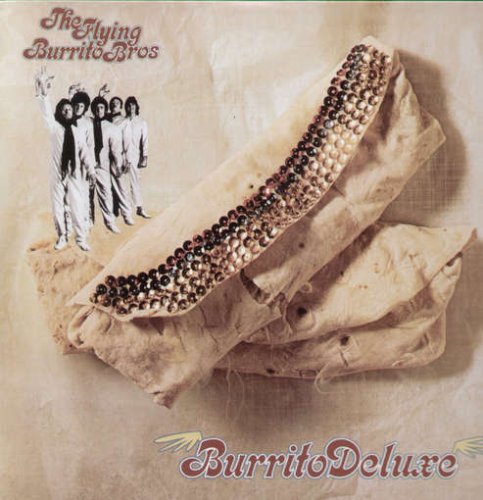
The Flying Burrito Bros, Burrito Deluxe (1970)


Less heavy-handed than the debut, it also weighs less, sometimes threatening to float away into jangly pop-rock—which is fine with me; frankly, I wish Parsons and Hillman both had taken more interest in that side of their work. GP had been kicking “Lazy Days” around for years before putting it on record here, and it sounds it—if Gilded Palace of Sin strove for the strains of 1938, this one eases into those of 1967. “High Fashion Queen” is sneering but effective, though the FBB—bros indeed—wallow in garden-variety rock misogyny that includes a zippy cover of Dylan's "If You Gotta Go," not one of his more charming moments.


They beat the Byrds to “Farther Along” by a year, though the two versions are largely interchangeable, and Parsons fumbles slightly on the closing “Wild Horses,” failing to bring Jagger’s depth of longing. Still, this brief excursion into a sort of power-pop country charts a direction not otherwise taken for this group--when Hillman dug "Down in the Churchyard" back out several years later on a solo album, it lumbered in at twice the length and half the impact. 

Monday, August 5, 2013

The Byrds, Younger Than Yesterday (1967)


Probably the only album in rock history in which a band recovers from a 3rd album slump by having the bass player take the lead songwriting role. What’s amazing is that Chris Hillman, for one record and one record only, very nearly fills Gene Clark’s shoes. “Have You Seen Her Face,” “Time Between,” Thought and Words,” they just roll out so seemingly effortlessly, pop-rock manna from four-string heaven. Throw in the slightly lesser (but still wonderful) “The Girl with No Name” and the Hillman/McGuinn co-written opener “So You Wanna Be a Rock ‘N’ Roll Star,” and this is Hillman’s greatest moment, a triumphantly jangly revitalization. Like floating garbage lifted by a rising tide, even David Crosby writes an actual song for once with “Renaissance Fair,” perhaps his finest turn.

This was probably the end of the line for this particular style of music; by the next year, you’d have to up your artistic ambitions or become the Monkees. It’s a delightful departure (I’m just gonna keep pretending Crosby’s “Mind Gardens” never happened).


Wednesday, July 24, 2013

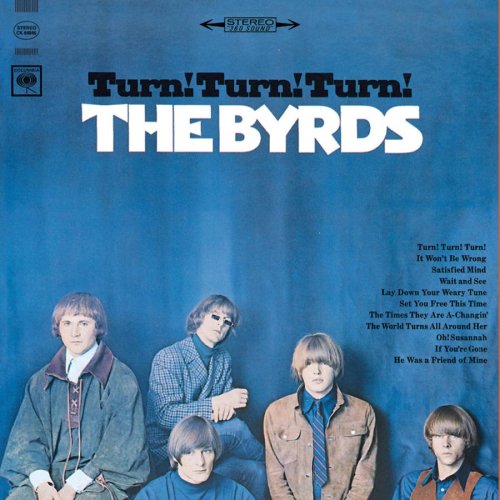
The Byrds, Turn! Turn! Turn! (1965)


Second verse, same as the first—to diminishing returns, but only slightly so. We still get revved-up Dylan covers (there’s no “please” in their command to get out of the new road in “The Times They Are A-Changin’”); splendid Gene Clark originals, all moody and brooding and yet possessed of lovely pop melodies; and scattered accoutrements that range from Porter Wagoner country hits to a few McGuinn stabs at pop-rock that aren’t half bad, the Herman’s Hermits to Clark’s Dylan-by-way-of-the-Beatles.

Nothing here is as game-changing as “Mr. Tambourine Man”—what within the Byrds framework could ever be again?—but the album takes on complicated (and problematic) weight as a last dying gasp of the American Camelot myth. The title track’s plea for peace would sound more desperate than prescient soon, and the expunged minstrel past of closing “Oh! Susannah” was a national repressed that was already returning (I won’t even go on a diatribe about Cold War bully John Kennedy, mourned in “He Was a Friend of Mine”; I’ll just sub in a link to Stephen Rabe’s compelling book The Most Dangerous Area in the World: John F. Kennedy Confronts Communist Revolution in Latin America). Anyone who takes this thing as pure simple pop music either votes Republican or hasn't listened very closely.

For all that baggage, and despite inexplicably leaving a few worthy Clark originals on the cutting room floor (“The Day Walk” is quite a loss), the thing hangs together, tenuously and anxiously jangle-rocking on the edge of oblivion. It already was too late, but maybe that was the point.


Wednesday, June 19, 2013

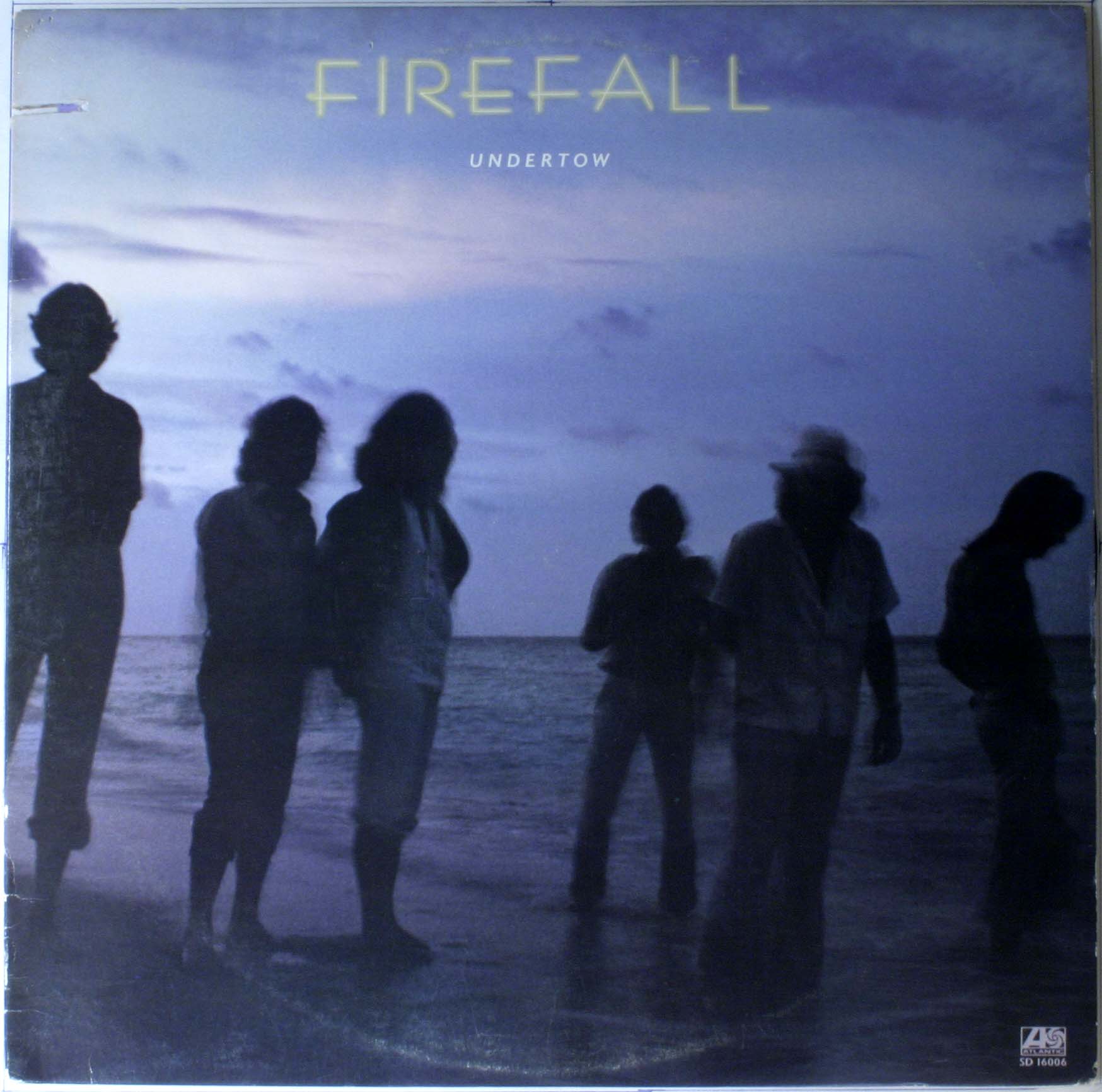
Firefall, Undertow (1980)


The 1979-80 season must have been a tough one for Larry Burnett, since he came up with a mere two ditties for this round; subtract one anomalously jaunty Jock Bartley jam buried safely deep on side 2, and this is effectively a Rick Roberts auteurist LP. His vision, of a sort of primordial silky ooze that runs from one song to the next as if discrete units of songwriting were a thing of the past (or possibly future) is nothing if not cohesive; this is probably my vote for Firefall’s best, though it manages to win the dubious honor without a single standout track. “Business is Business,” a Burnett track declares; indeed: the business here is that of polishing off every idiosyncratic edge from lyrical content to studio musicianship (the single proper noun on the entire album is a lone reference to California, and an impersonal one at that). As such, Michael Clarke’s rote 4/4 timekeeping—his recorded swan song before his revived faux-Byrds touring act and sadly early death—can almost be read as masterful; no distracting jazz flourishes here, that’s for sure. Let Steely Dan hire Jeff Porcaro for one verse, an older club veteran for the next; Clarke in some ways embodies the core of the Firefall project, all bland and anonymous and easy to listen to, hard to focus on.


That being said, more gripping and harrowing than any percussive work he offered in life was the graphic, grueling letter Clarke offered in death, detailing his alcoholism and warning children not to follow in his footsteps. Undertow has my favorite Firefall cover art, really some of my favorite 70s-malaise imagery altogether, all dark and brooding and ominous and as fuzzy about identity as Friedkin's Cruising (what any of this had to do with their music, I can't tell). But Clarke's visual decline is even more powerful, a sad and stark trajectory from pop heartbreaker to emaciated leftover. RIP to a guy who chanced into a pretty great run of it, and locked into a tragic one at the same time.


Sunday, May 19, 2013

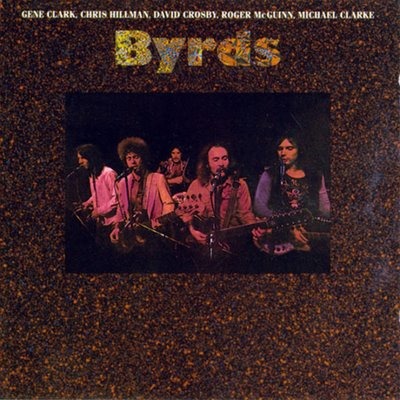
Byrds, s/t (1973)


The main thing a 1973 album featuring all five original Byrds (no "the" anymore, it seems) has going for it is low expectations; none of these dudes was near his prime by this point except for Gene Clark (and nobody seemed to care about him, inexplicably), so to hear this album rise to comfortable mediocrity is a pleasant surprise. That said, apparently nobody had lower expectations than the Byrds themselves, since most of them bring their scattered leftover songs rather than prime material, which they hoarded for their various solo pursuits. It’s like some unfortunate hybrid of the prisoner’s dilemma and the free rider problem.

It starts off strong, with Clark’s “Full Circle” (admittedly, recycled from his solo album Roadmaster, but given that that album only came out in, what, the Netherlands, I’ll call this fair) and another Clark tune on the first side; it’s smart enough to bury its two tuneless David Crosy atrocities on side two (one of which is also repeated, less excusably, from his own solo album of two years earlier). Chris Hillman gets two breezy little ditties that anticipate the effortlessly-forgettable Doobie Bros, and McGuinn even offers a decent folksy tune of his own (in addition to the bottom-feeding “Born to Rock’n Roll,” the sort of thing T-Rex did better but which should really not be done at all).

It’s rounded out by two Neil Young covers, bad ideas both. “Cowgirl in the Sand” comes at its most un-rocking, McGuinn’s claims notwithstanding, and while I understand the impulse to cover “(See the Sky) About to Rain,” truly one of the most beautiful songs in the Young songbook, not even Clark's vocals can top Young's own, and the band plays watered-down soft rock.

Why the back cover so emphasizes Hillman's splayed crotch, that I cannot say. 


Thursday, May 2, 2013

Gram Parsons/The Flying Burrito Bros., Sleepless Nights (1976)


For twelve songs squeezed out of a corpse, this isn’t half bad. Nine outtakes from the original Burrito Bros lineup in 1970 with Chris Hillman and the reliably dull Michael Clarke, and three Grievous Angels leftovers done with Emmylou Harris. It’s hard to ever dislike the Gram-and-Emmy Show—songs come and songs go, some better than others, but the two of them singing together sounds great regardless. There’s not an original composition in the bunch, but it’s freeing to hear GP stop striving for iconic status—always my least favorite aspect of his work—and just honky-tonk unto oblivion. Plus, the songs are well-chosen; why stop with one Merle Haggard tune when we can have two, the second of which is the perfectly plaintive death-row lament “Sing Me Back Home,” the album’s highlight? Otherwise, nothing here achieves classic status, but most of it falls just short. In a pinch, I’d probably take it over Grievous Angel.  


Friday, April 26, 2013

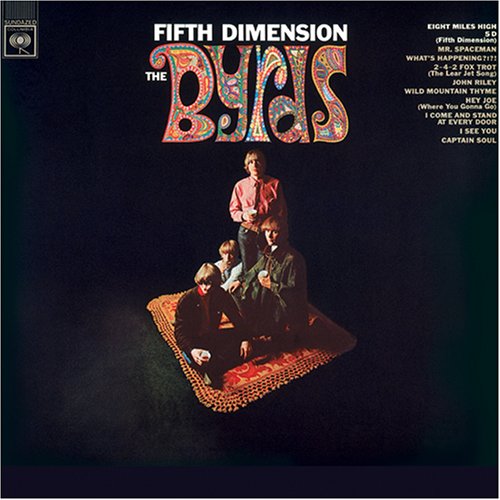
The Byrds, Fifth Dimension (1966)


When Roger (then still Jim) McGuinn explained in a 1965 interview that the Byrds were modifying folk music to “meet the nuclear expansion and jet age,” it sounded like a brilliant summation of the Zeitgeist. It turned out he just wanted to sing songs about airplanes; “2-4-2 Fox Trot (The Lear Jet Song)” here is just the first of many to follow. In its limp lethargy, it’s far from alone; I wouldn’t be the first to call Fifth Dimension a killer single with ten b-sides. If “Eight Miles High” was a departing gift from Gene Clark, his generosity was somewhat wasted. As the most heavily McGuinn-composed Byrds album to date, this reflected the hole at the center of the group. McGuinn has perilously little to say, and even padded out with covers and traditionals from “Hey Joe” to “John Riley,” the strain shows (his opening “5D (Fifth Dimension)” sounds like a Dylan cover, except with mushy roundabout lyrics). It could be worse, though—David Crosby’s debut solo songwriting credit “What’s Happening?!?!” anticipates decades of blathering pseudo-profundity from the insufferable Beat-aping man of boundless ego, but at least someone was smart enough to leave his equally tuneless “Psychodrama City” an outtake.

Credit where credit is due, though: McGuinn the songwriter ain’t much to marvel at, but his Coltrane-influenced guitar work, tested out a bit on “I See You” and then given full airing on “Eight Miles,” remains mindblowing. If only he had gone into some jazz-wonk underground instead of the bland rock that rendered him inert after this, unto eternity…


Sunday, April 21, 2013

The Flying Burrito Bros, s/t (1971)


The post-Parsons FBB fills his gap with future soft-rock maestro Rick Roberts—yet, instead of the expected sharp decline, it coalesces around a remarkably organic mellow cohesion that the first two lacked. Was Parsons a better songwriter? Yeah, probably (though Roberts offers more competition than you might expect based on his later Firefall sleepwalking). But Parsons always strained to cultivate his proto-urban-cowboy affect, whereas the lower-stakes Roberts songbook sounds like he’s actually been to Colorado on the song of that title. Chris Hillman takes a performing backseat, relegated to bass, but the four songs he co-wrote with Roberts have precisely the low-key appeal that Parsons, whatever his other merits, rarely achieved. Michael Clarke drums with the usual rote disinterest, but ghosts of Byrds past appear more vividly with the Gene Clark cover “Tried So Hard”—not first-class Clark material, but perfect for this album’s drowsy charm. If these guys had stepped out of the GP-shadows with a new band name, this one might be remembered for the soft gem it is, instead of being unfairly relegated to an imaginary aftermath. 

Wednesday, April 17, 2013

Firefall, Elan (1978)


Both lead singles are Rick Roberts jams, but Larry Burnett’s songs have a marginally more human feel, maybe just because of the dirty harmonica on “Wrong Side of Town,” maybe just because he oozes such sleaze that the stench of the organic finds its way into his songs, their insipid blandness failing to provide sufficient antiseptic measures. They also have a guy named Jock onboard (he'd been there from the start, and later he'd steal the group).

Whatever: third time at bat is neither better nor worse than the two before, though I liked it better when they reserved the band photo for the back cover. As always, the album slides in one ear, out the other, leaving little but a burnt-coke aftertaste. One does hope Michael Clarke was reading a good novel while nominally keeping time, because good Christ, my grandmother could do this. 

Thursday, April 11, 2013

Firefall, Luna Sea (1977)


It's easy to sound interesting about interesting things, they carry you along. And it's easy to rail compellingly against awful things, because who doesn't love a rant? But faceless mediocrity, that's always a challenge. I have this fantasy of editing an anthology in which I round up a bunch of my favorite authors and have them each compose an essay on Firefall's second album. Quite possibly nobody in the universe except me would be into this, but imagine: Civil War/Reconstruction historian Eric Foner, novelist Tim O'Brien, queer activist Sarah Schulman, hell, since it's a fantasy anyway, James Baldwin and Andrea Dworkin (content of arguments notwithstanding, she writes with fire and I'd love to see her tackle this, a paragon of the banality of patriarchal crooning), all really putting themselves to the test, because this LP gives you so very, very little to work with. Could they thrive so far outside their comfort zones? Or would they draw it inevitably back: Foner to the futility of Gettysburg, O'Brien to the postwar numbness, Schulman to pervasive heteronormativity, Baldwin to the fact that there is no fire this time?

That would be fascinating. Luna Sea, not so much. Somewhere inside its polished aural product Michael Clarke keeps time, thus the Byrds connection. But I played it four times back to back, and I already can't recall a single detail. Because there are none; this is what sonic airbrushing sounds like.

Maybe there's some culture-of-narcissism or deep-70s-malaise or even posthuman allegory to be worked out here, but I'm lazy and settled for Christgau-aping, having come up with this before surrender:
The diminishing returns begin with the title, and never stop. If the debut was Reheated Burrito Brothers, this is Grounded Burrito Bros.

Yeah, well, turns out Christgau himself took a stab at it, and flailed too (though well played at the end). Really the only thing I will ever remember about this album is my mental image of an aggravated Bob Christgau listening to it in 1977, walking in circles around his apartment, and cursing to himself.


Saturday, March 30, 2013

The Byrds, Mr. Tambourine Man (1965)


However obvious it sounds in retrospect, the fusing of Dylan and the Beatles was modern rock’s Cartesian moment (and for what it’s worth, cogito, ergo sum seemed pretty self-evident after the fact too). The LP never sounds like an historical artifact, either—forty years after the fact, it still exudes an uncontainable energy. So many genealogies begin here; McGuinn’s jangling guitar bequeathed Peter Buck and indie rock as we know it, and even Michael Clarke, never the world’s greatest drummer, brings a striking visual cool, all t-shirts and eyes buried under hair and sullen lips, looking like nothing so much as a young Thurston Moore. 

The real secret genius, though, is Gene Clark; any band can cover Dylan, but few could deliver originals like his. Bashing out one perfect pop gem after another, he makes it sound easy, so that when the bridge on “You Won’t Have to Cry” threatens to climb a step into straight-up wanna-hold-your-hand-ness, it’s possible to read it as a sophisticated joke rather than aping and have some ground to stand on. Maybe it’s both. Either way, “I’ll Feel a Whole Lot Better,” “Here Without You,” It’s No Use,” etc.: ten of the album’s twelve tracks (and all of the originals) clock in under three minutes, often well under (Dylan's "Spanish Harlem Incident" was short; theirs is shorter by 20%, not even two minutes long!), reflecting an intuitive awareness of pop mechanics at their finest; crawl into the ear, get out quick, and leave a lasting earworm. Every single Clark composition is A-side material, every single cover an assertive act of ownership. The American rock LP nearly peaked here, at its birth. 

Saturday, March 16, 2013

Firefall, s/t (1976)


In the soft-rock-sterility songwriting contest between Rick Roberts and Larry Burnett, we all lose. There’s a faint trace of the core Byrds here, with Chris Hillman picking up a co-writing credit (with Roberts and Stephen Stills) on the modestly captivating “It Doesn’t Matter,” but really Michael Clarke—who mostly does little more than stay in time—is the main link. According to the back cover, he hasn’t aged too well; his lost years were apparently not spent at the practice kit. Otherwise it’s so-soft-it-melted rock all the way through, with songs about love, dolphins, and Cinderella (on the latter of which, Burnett wins some kind of alltime-dick award for shunning a woman he got pregnant and sending her on her way; stay classy, ye gods of MOR FM radio). Props for burying the big hit single “You Are the Woman” deep on side 2, I guess. I like their later album art more, and arguably the albums too.