Showing posts with label Roger McGuinn. Show all posts

Tuesday, September 6, 2016

The Chad Mitchell Trio, Mighty Day on Campus (1961)


Is there anything more awkward than a trio with four members? Poor Jim McGuinn stands at arm’s length on the cover, and gets buried in a shadow on the back, but the place he’s hidden best is on the record itself, where he holds his banjo and . . . well, doesn’t do much. He whips up a little jangle-fire on “Whup Jamboree,” but this generally staid music, Peak Whitebread Pre-Dylan Folk with songs about the temperance movement and Lizzie Borden and a super skier. “Dona Dona Dona” is pretty, and nothing's too terribly dire, but it probably felt good for McGuinn to plug his guitar in and help lay this era to rest a few years later.

It was cool to see Bob Pollard producing and writing liner notes, but then I looked closer and it was actually Bob Bollard, so, bummer there. His notes call the crowd at this live show "wild," but it's important to remember, the Sixties hadn't happened yet.


Sunday, August 3, 2014

Roger McGuinn, Back from Rio (1991)


After some time off here, a comeback album seems about right. And to give credit where credit due, while McGuinn has always seemed clueless, whichever A&R dude came up with this knew what he was doing—as far as I can tell, the basic logic was, “McGuinn can’t write a song to save his life, but he can still make a guitar jangle, so let’s just bury him in purchased talent and pray he follows their leads.”

He does. When the guitar on the second track momentarily seems to launch into “So You Wanna Be a Rock and Roll Star,” it might be a knowing wink, or it might signify the creative dead end McGuinn had been stalled at for twenty years, but the thing is, it doesn’t matter: it’s sharp and punchy, and it doesn't pause to think. In many ways this is second-tier major-label rock at its finest.

Okay, not always lyrically. “Car Phone” comes about ten years late (wasn’t McGuinn himself already carrying a mobile phone on the cover of The City ten years ago? Maybe it was a walkie-talkie, but whatever—this is get-off-my-lawn music); “The Trees Are All Gone” is nearly trite enough to be a Graham Nash eco-ballad; “Your Love is a Gold Mine” takes a deeply unpromising structuring conceit, and excavates every ounce of forced metaphor it can. When Elvis Costello shows up to write some snarling music-biz swipes at a sell-out on “You Bowed Down,” it’s positively not 4th street, but maybe somewhere in the vicinity. Yet it seems a little rich being sung by the guy who’s been the Platonic embodiment of bland corporate rock since at least the early 70s.

But Back from Rio hardly lives or dies by its words; they’re more like a rhythm section to hang the hooks on, and there, it delivers. McGuinn jangles. The melodies soar and crash into rousing choruses. There’s not a dud track here—and there damn well shouldn’t be, since the suits brought in ex-Byrds (Hillman and Crosby), Costello, Tom Petty and a good chunk of the Heartbreakers, Michael Penn, Dave Stewart, Jules Shear on songwriting duty, and even outlier Stan Ridgeway for a cameo. It might be akin to shooting a dying athlete full of speed for one last game, but McGuinn stays awake all the way through.

Alas—and an “alas” is inevitable with a McGuinn solo LP: the track lengths. Good Christ, they drag. The first few Byrds albums often hovered around two minutes per track, and were perfect for it; here, songs lumber to their death at double that, and needlessly so. “King of the Hill” is a killer duet between McGuinn and Petty, but at 5:27 it’s practically a goddamned Soundgarden tune, running itself painfully into the ground. Did Arista pay so much for the hired help that it insisted on squeezing extra choruses out of them? I have no idea, but it’s a colossal mistake. Every song here is good-to-very-good on the merits; every song here is also too long by a minimum of 30%, and the result is a plodding record that, pared down, could easily stand with the best of the non-Parsons/Clark post-Byrds albums. McGuinn co-wrote “The Time Has Come,” but sadly, did not sufficiently think through its implications.


Saturday, April 5, 2014

The Byrds, Live at the Fillmore, February 1969 (2000)


No question  about it, I was a skeptic: the damn band put out a live record in 1970, so what’s the point of this beyond cynical label cash-grab?

And probably that was the point, since what else motivates labels? But that doesn’t stop this from asserting its own identity, independent of (Untitled), and capturing the band precisely at a transitional moment. It had only been four years since they broke big, but it seemed careers ago; they’re clearly eager to move beyond the past, cramming “Turn! Turn! Turn!”, “Mr. Tambourine Man,” and “Eight Miles High” into one oldies-hit-parade medley that they blast through in a ten-minute fury (as opposed to the sprawling side-long “Eight Miles” on the 1970 record). It works—while McGuinn is rarely an impassioned singer (to his frequent detriment), he shouts himself hoarse on a “So You Want To Be a Rock’N’Roll Star” that could nearly pass as a punk band in 1978, all clanging chords and John York swooping through on bass.

But the band wants to play its new material, and while the just-released Dr. Byrds and Mr. Hyde was hardly a high point, they rock “King Apathy III” as if it were, and almost convince. McGuinn’s vocals on the tracks that Gram Parsons would also claim separately (esp. “Sing Me Back Home” and “Close Up the Honky Tonks”) can’t help suffering in comparison, but he and the rest of the group seethe through a fantastic “This Wheel’s on Fire,” and close things out with more Dylan, a rousing “Chimes of Freedom.” Even the generally lackluster “He Was a Friend of Mine”—always one of my least-favorite Byrds songs, a treacly tread of misplaced nostalgia—comes to life. I still have no idea why both McGuinn and Parsons were so thin-skinned about being dissed by a DJ that they both kept “Drug Store Truck Drivin’ Man” in their sets, but at least it dies before the 2:30 mark. Even David Fricke’s liner notes deliver—the idea of the first Byrds show at the Fillmore, in 1966, occurring alongside a production of LeRoi Jones’ The Dutchman is just kind of astonishing—as is the fact that they were reduced to opening for some Butterfield Blues Band dudes by the point of this recording. Huh? 


Thursday, February 13, 2014

The Byrds, Dr. Byrds and Mr. Hyde (1969)


Clarence White is here, and he ain’t yer Sweetheart: he rings this LP in with some crashing chords that bring “This Wheel’s on Fire” closer to Blue Cheer than Gram Parsons. Later, fellow Byrd-n00b Gene Parsons adds such a cavernous drum sound to “Child of the Universe” that one might mistake it for a guest appearance from John Bonham. This is what happens when you repopulate a rock band in 1969, apparently. 

Dr. Byrds and Mr. Hyde is an odd, deeply uneven LP, lost in the shadows of 1968’s moment in the sun, and their biggest commercial dud, according to David Fricke’s reissue liner notes (which strive nobly, if futilely, to reclaim it as "the Great Forgotten Byrds Album"--it is one of those things, but not both). I’ve been listening to it every other year or so for a decade, and have only just begun to appreciate it, so I guess it’s what you’d call a grower. Still, it has its moments: “Old Blue” proves you can’t go wrong singing about a favorite dog, and “Bad Night at the Whiskey” is a great title for an anomalous outlier at the rockier end of the Byrds spectrum. There’s some dumb, lazy political commentary in “King Apathy III” and “Drug Store Truck Drivin’ Man” (a McGuinn/Gram Parsons co-write that the latter would also play, and also fail to bring to life), and I’m not sure why White and the new Parsons imported some of their Nashville West jamming, but all the confusing twists and turns do ultimately make for an unpredictable, if muddled, one-off experiment. Clunky as the title is, it captures the schizoid feel of this one. And that title-font, wow. 


Friday, January 24, 2014

The Byrds, Preflyte (1969)


I know their artistic ambitions aspired to ever loftier terrain, but I like the Byrds* as a simple pop band, which is exactly what Preflyte delivers. Recorded in 1964, when they were just five cute, goofy young men posing on the back cover with rifles (Gene Clark, unarmed and pensive, hides behind a scrawny tree, naturally), but leaked only in '69, this delivers eleven songs in 25 minutes, only one topping 2:30, and then by a mere second. Some are dry runs for album tracks, and none are holy grails of lost song, but “You Showed Me” reclaims a McGuinn/Clark composition from its better-known Turtles hit, and Gene Clark has never rocked as unselfconsciously as he does on “You Movin’,” surely the most Beatles-dance-party song he ever wrote. I can imagine the older, wiser, sadder Clark sneering at it, but for two shouted, stomping minutes, it’s the best thing in the world.

* I only just noticed that the only place the Byrds are actually named on this LP is in the liner notes--not on the cover, side, or record itself. So technically it should be credited to Jim McGuinn, Gene Clark, David Crosby, Chris Hillman, and Michael Clarke--but to hell with that. 

Monday, August 26, 2013

The Byrds, Ballad of Easy Rider (1969)


As a rule, albums whose second tracks are written by the new bass player about a dog and feature a mid-song drum solo are to be avoided at all costs. Yet somehow Ballad of Easy Rider proves an (most likely the) exception—and the best late-Byrds LP. McGuinn spends his entire songwriting capital on the lovely opening title track, one of his greatest moments, but the rest of the band steps up admirably, from short-term bassist John York and his aforementioned “Fido,” to co-writers Clarence White and Gene Parsons, whose “Oil in My Lamp” provides another high point. One could read the abundance of covers—there are a lot even by Byrds standards—as a sign of creative exhaustion, but they also reflect curatorial sense and wisdom, with “Tulsa County” and Woody Guthrie’s humane, still sadly relevant “Deportee (Plane Wreck at Los Gatos)” delivered with feeling. It’s a soft, understated record, all the better for not striving to be iconic.


Okay, McGuinn can’t hold back from ending things on another of his stupid spaceship songs, but even that brings a loopy charm.

Monday, August 5, 2013

The Byrds, Younger Than Yesterday (1967)


Probably the only album in rock history in which a band recovers from a 3rd album slump by having the bass player take the lead songwriting role. What’s amazing is that Chris Hillman, for one record and one record only, very nearly fills Gene Clark’s shoes. “Have You Seen Her Face,” “Time Between,” Thought and Words,” they just roll out so seemingly effortlessly, pop-rock manna from four-string heaven. Throw in the slightly lesser (but still wonderful) “The Girl with No Name” and the Hillman/McGuinn co-written opener “So You Wanna Be a Rock ‘N’ Roll Star,” and this is Hillman’s greatest moment, a triumphantly jangly revitalization. Like floating garbage lifted by a rising tide, even David Crosby writes an actual song for once with “Renaissance Fair,” perhaps his finest turn.

This was probably the end of the line for this particular style of music; by the next year, you’d have to up your artistic ambitions or become the Monkees. It’s a delightful departure (I’m just gonna keep pretending Crosby’s “Mind Gardens” never happened).


Wednesday, July 24, 2013

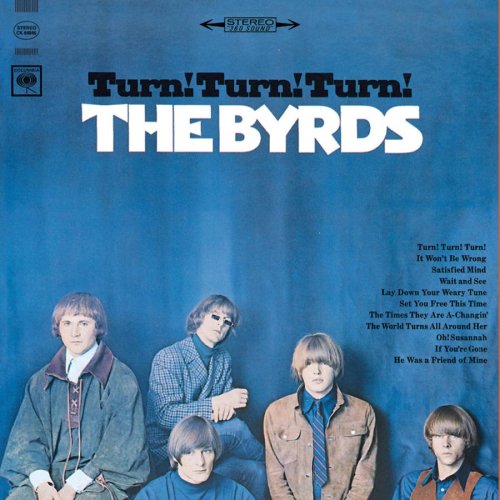
The Byrds, Turn! Turn! Turn! (1965)


Second verse, same as the first—to diminishing returns, but only slightly so. We still get revved-up Dylan covers (there’s no “please” in their command to get out of the new road in “The Times They Are A-Changin’”); splendid Gene Clark originals, all moody and brooding and yet possessed of lovely pop melodies; and scattered accoutrements that range from Porter Wagoner country hits to a few McGuinn stabs at pop-rock that aren’t half bad, the Herman’s Hermits to Clark’s Dylan-by-way-of-the-Beatles.

Nothing here is as game-changing as “Mr. Tambourine Man”—what within the Byrds framework could ever be again?—but the album takes on complicated (and problematic) weight as a last dying gasp of the American Camelot myth. The title track’s plea for peace would sound more desperate than prescient soon, and the expunged minstrel past of closing “Oh! Susannah” was a national repressed that was already returning (I won’t even go on a diatribe about Cold War bully John Kennedy, mourned in “He Was a Friend of Mine”; I’ll just sub in a link to Stephen Rabe’s compelling book The Most Dangerous Area in the World: John F. Kennedy Confronts Communist Revolution in Latin America). Anyone who takes this thing as pure simple pop music either votes Republican or hasn't listened very closely.

For all that baggage, and despite inexplicably leaving a few worthy Clark originals on the cutting room floor (“The Day Walk” is quite a loss), the thing hangs together, tenuously and anxiously jangle-rocking on the edge of oblivion. It already was too late, but maybe that was the point.


Wednesday, July 3, 2013

The Byrds, (Untitled) (1970)


Untitled and also seemingly rather unsung, but a remarkably strong album with an adventurous format: double-LP, first one live, second new studio tracks. They bring the muscle for the live stuff, with a set spirited enough to reclaim even the doofy “Mr. Spaceman” from its 5th Dimension doldrums. “Lover of the Bayou,” one of McGuinn’s last strong originals, opens things—live rather than studio was the right call—and an entire sidelong “Eight Miles High” avoids feeling like one of those awful San Francisco jam bands stretching out aimlessly in some poor ballroom; these guys hammer ferociously.

The studio material contains more solid McGuinn/Levy compositions (“Just a Season” especially), and balances nicely against the live record. The Skip Battin/Kim Fowley songwriting machine that would irreparably mar the next two Byrds albums begins to seep in here, but is held slightly in abeyance by the fact that McGuinn takes the mic, and these actually sound like rock songs and not irritating novelty tunes—though the concluding “Well Come Back Home” drones on twice as long as it should.

That we're pretty far from "Mr. Tambourine Man" is signified by the brief two-minute rendition it gets, squeezed late on side 1--the Byrds could never escape their folk-rock origins, but they race through it to better move on to where they're now at. It's a better place than one would be primed to imagine.


Tuesday, June 18, 2013

Roger McGuinn (1973)


McGuinn still can’t write, but having Bob Dylan play harmonica on an opening track that sounds like a Dylan cover almost works. Other minor pleasures are to be found: a catchy melody on “M’Linda,” a random children’s chorus popping up on “Stone,” a few traditionals given nice 70s-rock arrangements. But the original five Byrds reunite (again) for “My New Woman” only to be drowned out by a gratuitous sax, and while “Lost My Drivin’ Wheel” fares better, it makes one miss Clarence White and Gram Parsons, who brought more fire to a version inexplicably left off Farther Along. “Hannoi Hannah” is about a mean joke played on a prostitute (typically classy lyrics by Jacques Levy), and the Moog experiment “Time Cube” is a mean joke played on the listener. So things aren’t great here—and on subsequent McGuinn solo efforts, they’d only rarely get better.


Wednesday, June 12, 2013

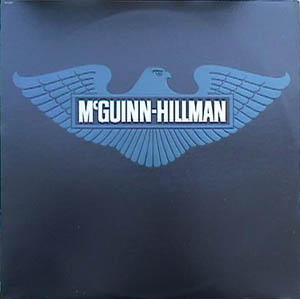
McGuinn-Hillman (1980)


I have no idea who opened for Loverboy or Eddie Money in 1980, but I do know, with absolute certainty, that they sounded exactly like this album: crisp ringing trebly guitar chords hanging in the air, faux-anthemic synth climbs to anticlimactic pseudo-crescendos, plenty of open space for live handclaps, and not a song in sight. Drowning out the sad, lazy all-filler tracks is the giant sucking sound of the now-absent Gene Clark, responsible for many of the best moments in the previous McGuinn-Hillman affairs. In his place are a nonsensically sequenced consecutive double whammy of Graham Parker tunes on side 1, a procession of farmed-out hack-written songs neither better nor worse than the former Byrds’s inert originals, and the grinding death throes of the promises of the 1960s. I guess this is what America deserved for electing Reagan.

Capitol seemed to know this one was slated for oblivion; as far as I can tell, between the front and back covers, the target audience for this LP was inattentive bikers impulse-buying based on the logo, sunburn victims, and barefoot survivalists surfacing from their fallout shelters to buy batteries.


Tuesday, June 4, 2013

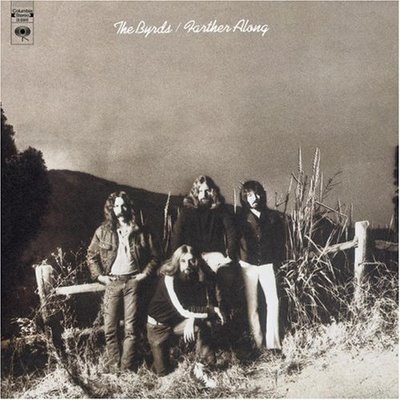
The Byrds, Farther Along (1971)


Timing and production, they matter: I could see this ramshackle album recorded on a four-track in 1996 getting some underground traction, and I could see it slathered in Byrdsmaniax overdubs, coming out in 2007 on Sub Pop as a Fleet Foxes opening act. Recorded near-live in 1971, right after the aforementioned flop, it too wilted on the vine. If not a lost masterpiece, it still deserved better, as Gene Parsons and Clarence White really showed themselves the center of the group, Roger McGuinn overcame his lifelong songwriting stupor to kick things off with the self-penned chugging 50s-style riffage of “Tiffany Queen” (one of the most overlooked Byrds gems, with even modestly clever lyrics from Our Man of the Norman Vincent Peale Reading Club), and the wretched Skit Battin/Kim Fowley songwriting duo pushed their obnoxiousness into relative remission here. We even get a moving dead-dog tribute.

Probably this was all they had in them and it’s just as well the road ended here (it’s the final LP in the organically continuous life of the Byrds, with the 1973 original-lineup return a reunion rather than a next-album). But the thing deserved better than the critical and commercial neglect it received—even the bonus tracks on the CD reissue kinda kill it.  


Saturday, June 1, 2013

The Byrds, Byrdmaniax (1971)


The near-universal consensus is that producer Terry Melcher killed this album by drowning it in sickly sweet strings and horns. Which gives him both too much and too little credit; okay, he lays it on thick, no question, but this was bound for mediocrity no matter who tweaked the knobs. Nothing could polish these tunes into gold, nor does Melcher entirely stifle what is there; McGuinn’s gentle but simple “Kathleen’s Song” was going to be endearing but forgettable whether or not swirling symphonic fills were crammed into its open spaces.

That and the Gene Parsons co-write “Pale Blue” are the fearless leader’s most—only—valuable contributions (the less said about his faltering stab at political commentary, “I Wanna Grow Up To Be a Politician,” the better; on his go-to co-composer Jacques Levy, let even less be said). Team Battin/Fowley can’t compete with even that, turning in more of the lazy pap that marked Battin’s Byrdsian contributions. Clarence White moves behind the mic for a few songs, credibly enough, though surely even the young Jackson Browne had better offerings for him to cover than “Jamaica Say You Will.”


At least they were smart enough to leave off the once-requisite Dylan cover that traded in and simplified the complicated sneer/sorrow combo of “Just Like a Woman” for a more straightforwardly sentimental version that thus missed the point.  Otherwise, all the markings of a slapdash contract filler are here, including the goofy, unappealing cover and title. Ladies and gentlemen, this is what uninspired journeyman rock music feels like.

Sunday, May 19, 2013

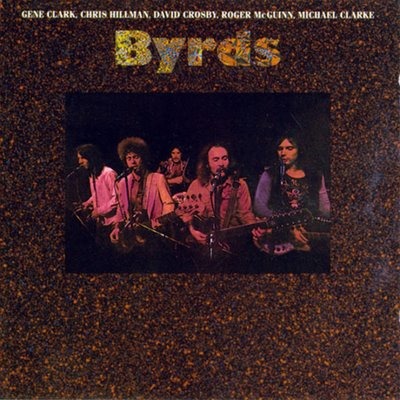
Byrds, s/t (1973)


The main thing a 1973 album featuring all five original Byrds (no "the" anymore, it seems) has going for it is low expectations; none of these dudes was near his prime by this point except for Gene Clark (and nobody seemed to care about him, inexplicably), so to hear this album rise to comfortable mediocrity is a pleasant surprise. That said, apparently nobody had lower expectations than the Byrds themselves, since most of them bring their scattered leftover songs rather than prime material, which they hoarded for their various solo pursuits. It’s like some unfortunate hybrid of the prisoner’s dilemma and the free rider problem.

It starts off strong, with Clark’s “Full Circle” (admittedly, recycled from his solo album Roadmaster, but given that that album only came out in, what, the Netherlands, I’ll call this fair) and another Clark tune on the first side; it’s smart enough to bury its two tuneless David Crosy atrocities on side two (one of which is also repeated, less excusably, from his own solo album of two years earlier). Chris Hillman gets two breezy little ditties that anticipate the effortlessly-forgettable Doobie Bros, and McGuinn even offers a decent folksy tune of his own (in addition to the bottom-feeding “Born to Rock’n Roll,” the sort of thing T-Rex did better but which should really not be done at all).

It’s rounded out by two Neil Young covers, bad ideas both. “Cowgirl in the Sand” comes at its most un-rocking, McGuinn’s claims notwithstanding, and while I understand the impulse to cover “(See the Sky) About to Rain,” truly one of the most beautiful songs in the Young songbook, not even Clark's vocals can top Young's own, and the band plays watered-down soft rock.

Why the back cover so emphasizes Hillman's splayed crotch, that I cannot say. 


Friday, May 10, 2013

Roger McGuinn and Band (1975)


Rock democracy has a pretty checkered history, unless you consider Stu Cook a songwriter on par with John Fogerty or want to hear some random guy sing about his air mattress on a Conor Oberst album. When Roger McGuinn undertook a songwriting democratization on his third solo album, however, rather little was at stake; his first two albums were already awash in hired-hack-written tunes. Plus, they were both mediocre at best, so what was bringing the boys from the band in gonna do, wreck a winning streak?

Hardly. The backup dudes hold their own against McGuinn, though it’s a lightly stacked balance beam on both ends (still better than the first two solo albums, admittedly). Bassist Stephen Love opens with the slick, radio-ready “Somebody Loves You,” and while the other guys bog down side 1 with songs about a dog and painted ladies (they represent better on side 2), they’re still closer to quality than McGuinn’s soggy run through “Knockin’ on Heaven’s Door.”  Plus, the fearless leader is reduced to retrieving his own “Lover of the Bayou” from the opening-track slot on a 5-year-old Byrds album, hardly plucked from obscurity but rather reeking of desperation. At least it has a fiery guitar solo, rare proof that McGuinn was awake for at least one moment in the 1970s.


Friday, April 26, 2013

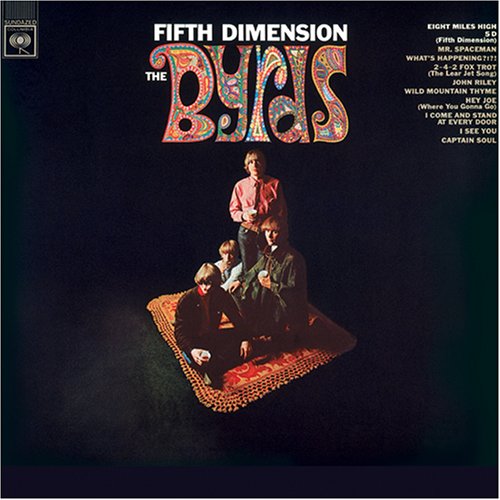
The Byrds, Fifth Dimension (1966)


When Roger (then still Jim) McGuinn explained in a 1965 interview that the Byrds were modifying folk music to “meet the nuclear expansion and jet age,” it sounded like a brilliant summation of the Zeitgeist. It turned out he just wanted to sing songs about airplanes; “2-4-2 Fox Trot (The Lear Jet Song)” here is just the first of many to follow. In its limp lethargy, it’s far from alone; I wouldn’t be the first to call Fifth Dimension a killer single with ten b-sides. If “Eight Miles High” was a departing gift from Gene Clark, his generosity was somewhat wasted. As the most heavily McGuinn-composed Byrds album to date, this reflected the hole at the center of the group. McGuinn has perilously little to say, and even padded out with covers and traditionals from “Hey Joe” to “John Riley,” the strain shows (his opening “5D (Fifth Dimension)” sounds like a Dylan cover, except with mushy roundabout lyrics). It could be worse, though—David Crosby’s debut solo songwriting credit “What’s Happening?!?!” anticipates decades of blathering pseudo-profundity from the insufferable Beat-aping man of boundless ego, but at least someone was smart enough to leave his equally tuneless “Psychodrama City” an outtake.

Credit where credit is due, though: McGuinn the songwriter ain’t much to marvel at, but his Coltrane-influenced guitar work, tested out a bit on “I See You” and then given full airing on “Eight Miles,” remains mindblowing. If only he had gone into some jazz-wonk underground instead of the bland rock that rendered him inert after this, unto eternity…


Saturday, April 20, 2013

Roger McGuinn and Chris Hillman, featuring Gene Clark, City (1980)


The group has been realigned to McGuinn and Hillman, featuring Gene Clark, with the latter turning in one-per-side songwriting duties. Plenty of the other songwriting is farmed out, and you need not be a rockist all invested in authenticity and whatnot to find that a little perverse (or telling). The album actually benefits from its atrocious artwork (with the two leads clean-cut and business-dressed as yuppies in a set of photos plastered against a Wall Street backdrop; the Byrds as Jerry Rubin and Abbie Hoffman?)—expectations are so low that, when the bland pleasantries begin, they’re surprisingly refreshing. Anyone expecting incisive commentary on the urban crisis will be let down by McGuinn’s “The City,” but “Skate Date” is a song where he seems to embrace his banality and run with it for three silly enjoyable minutes; I hum this song so much that my partner, who may not ever have heard it, now hums it too, second-hand. Clark’s “Won’t Let You Down” is more Byrdsian classicism filtered through questionable 70s production, a high point of the album and the latter part of his sad career, while Hillman’s songs are marginally more lively than his solo LPs from this era. 
Overall, some of the best utter mediocrity of the late 70s. 

Sunday, April 7, 2013

Roger McGuinn, Cardiff Rose (1976)


Bringing in Mick Ronson on guitar is perhaps the only brilliant move in McGuinn’s entire lackluster solo career. His songwriting remains abysmal—the solo-writing-credit “Friend” relies on rhyme schemes that a fifth grader might come up with—but Ronson brings some pizzazz, raunching up even the closing Joni Mitchell cover “Dreamland.” McGuinn occasionally rises to the challenge—zone out a little (easy to do, as it’s still a McGuinn solo LP) and “Rock and Roll Time” sounds like the Clash. “Partners in Crime” is a wince-inducing survey of New Left heroes, but the Blood on the Tracks outtake “Up to Me” is a really smart pick for the requisite Dylan material, since it was the only version available at the time. For all this, the album only rates as decent—but that’s enough to qualify as McGuinn’s peak to date. 

Saturday, March 30, 2013

The Byrds, Mr. Tambourine Man (1965)


However obvious it sounds in retrospect, the fusing of Dylan and the Beatles was modern rock’s Cartesian moment (and for what it’s worth, cogito, ergo sum seemed pretty self-evident after the fact too). The LP never sounds like an historical artifact, either—forty years after the fact, it still exudes an uncontainable energy. So many genealogies begin here; McGuinn’s jangling guitar bequeathed Peter Buck and indie rock as we know it, and even Michael Clarke, never the world’s greatest drummer, brings a striking visual cool, all t-shirts and eyes buried under hair and sullen lips, looking like nothing so much as a young Thurston Moore. 

The real secret genius, though, is Gene Clark; any band can cover Dylan, but few could deliver originals like his. Bashing out one perfect pop gem after another, he makes it sound easy, so that when the bridge on “You Won’t Have to Cry” threatens to climb a step into straight-up wanna-hold-your-hand-ness, it’s possible to read it as a sophisticated joke rather than aping and have some ground to stand on. Maybe it’s both. Either way, “I’ll Feel a Whole Lot Better,” “Here Without You,” It’s No Use,” etc.: ten of the album’s twelve tracks (and all of the originals) clock in under three minutes, often well under (Dylan's "Spanish Harlem Incident" was short; theirs is shorter by 20%, not even two minutes long!), reflecting an intuitive awareness of pop mechanics at their finest; crawl into the ear, get out quick, and leave a lasting earworm. Every single Clark composition is A-side material, every single cover an assertive act of ownership. The American rock LP nearly peaked here, at its birth. 

Saturday, March 23, 2013

McGuinn, Clark & Hillman (1979)


This must have made sense in 1979: three former Byrds, all equally washed up artistically and commercially, getting back together for some of that old magic. It doesn’t happen, of course, though Hillman’s lead track “Long Long Time” has some power-pop zest all too absent from his other solo work. I could see the Plimsouls rocking this.

McGuinn and Clark phone their songs in; the only moxie they bring is in their apparent competition to see who can unbutton his shirt the furthest on a cover shot, with McGuinn winning at near-belly-button depth. With a cross-bearing necklace, Clark looks sleazier, though, grizzled and mean like Rip Torn in Payday, which probably wasn’t far off (his lazy groupie-grabbing “Backstage Pass” only adds to the image). “Release Me Girl” answers the question, what would Gene Clark sound like with a disco-lite arrangement, if anyone was wondering, like some watered-down leftover from No Other, and McGuinn’s closing “Bye Bye, Baby” is fairly lovely if one can hold awareness of the abysmally insipid lyrics at bay. Otherwise, nothing to report here.

Oh, there are unfortunately-placed liner notes on the cover that declare the album has “a timeless quality … that renders analysis insignificant.” Whoever Stephen Peeples is or was, hopefully he felt shame for writing that. Which is not to say further analysis would be effort well spent.